
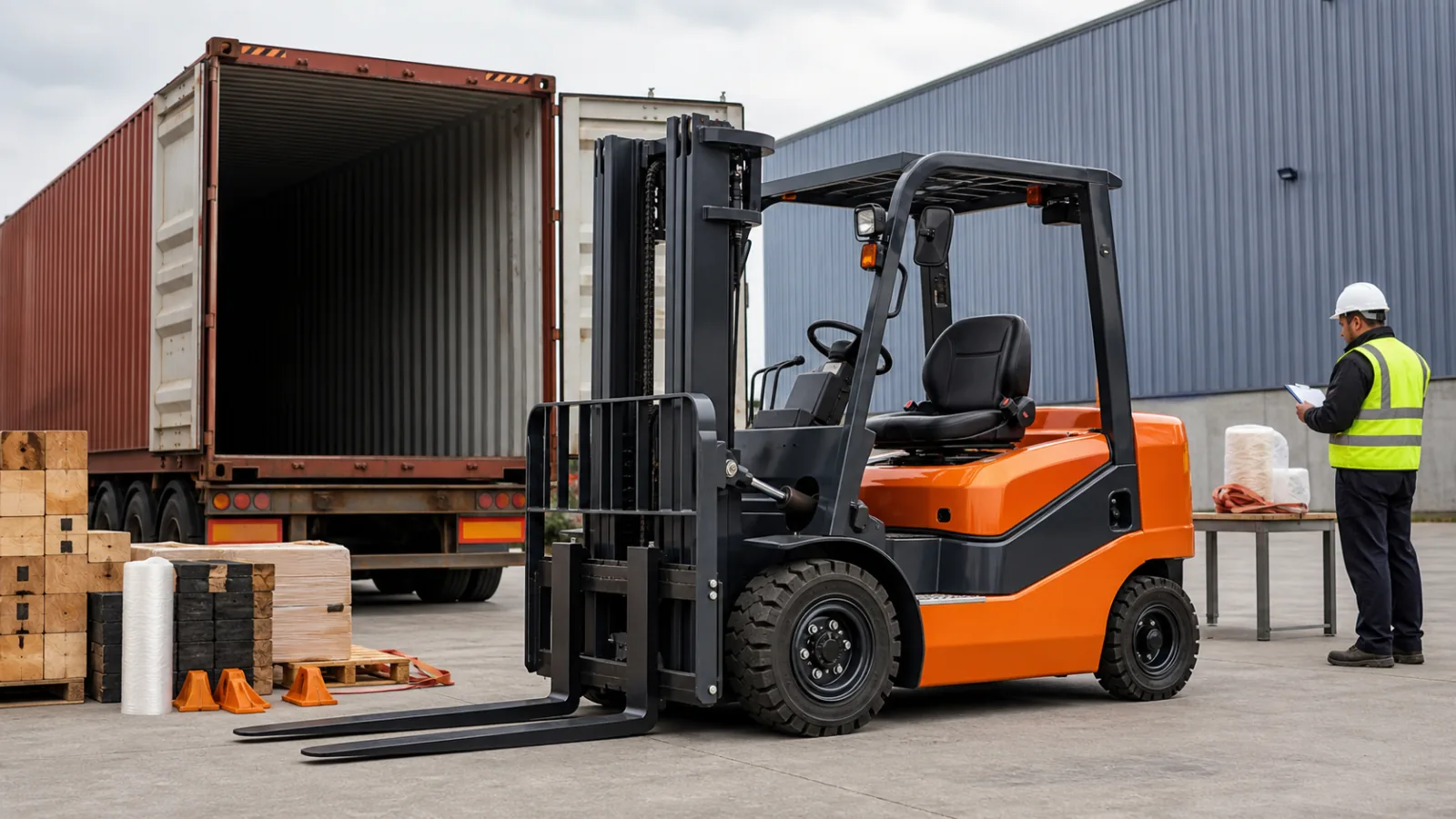
Importing forklifts from China is straightforward when your RFQ is complete: model, quantity, destination country and port, configuration, required documents and target lead time. This checklist walks the full process — quotation, order, production, inspection, packing, shipping and after-sales — and the paperwork each step needs. HONGLI quotes FOB factory-direct with a one-unit minimum, a production schedule confirmed with the quotation and CE documentation available on request; bring this checklist and you’ll get a firm quote fast.
This guide is the industry process, written by a factory that lives inside it. Where Hongli Machinery’s own practice illustrates a step, we say so — and the same checks we describe should be applied to us as to anyone.
Step 1 — Shortlist real factories, not trading companies
A large share of “manufacturers” on B2B platforms are trading companies reselling factory machines with a margin and a delay. There is nothing illegal about that, but you pay more, learn less, and lose the direct line to the people who built your machine when something needs solving.
How to tell the difference: ask for the company’s registered name and check it (a manufacturer’s registration says manufacturing, ours reads Tai’an Hongli Mechanical Equipment Co., Ltd.); ask for a live video walk of the production line, not a showreel; ask a technical question — load centre de-rating, mast options, battery chemistry — and see whether the answer comes from an engineer or a script. A factory visit remains the gold standard, and a serious supplier will encourage it.
Step 2 — Verify certificates before you pay anything
Certificates are per model and per market, and this is where careless buyers get hurt. “CE certified” as a blanket claim means little; what counts is a conformity document naming the model you are buying, issued by an identifiable body, current on date. For the EU, notified bodies carry public numbers you can check against the official NANDO database. Ask for the certificate for your model and your market, and check it against your import rules before the deposit moves. A supplier who hesitates at this request has answered your real question.
Step 3 — Lock the specification and the contract
The proforma invoice should read like a machine’s biography: model, capacity, load centre, lift height, battery or engine type, tyres, options, color, quantity, price terms (FOB/CIF and port), lead time, payment terms and what documents ship with the goods. Vague proformas produce wrong machines.
Payment norms in this industry: around 30% T/T deposit with order and the balance before shipment — Hongli’s standard terms are exactly that. Treat requests for 100% upfront from an unverified supplier as the red flag it is, and treat your own wish to pay 0% upfront as equally unrealistic; the deposit is what schedules your production slot.
Step 4 — Inspect before the machines ship
You are buying machines you have not touched, so build verification into the order. Ask for photos and video during production and at packing. For first orders or large ones, commission a third-party inspection — SGS, BV or your own agent at the factory — with a load test on the list. A factory confident in its pre-delivery testing will welcome this; Hongli runs a seven-step test on every unit (hydraulics, full-function run, rated-load test, engine, travel, electrics, final QC) and treats third-party inspectors as routine guests.
Step 5 — Shipping and documents
Most forklift exports move FOB from a Chinese port — Qingdao, in our case — meaning your freight forwarder books the vessel and owns the goods’ journey from the rail. If you would rather not manage freight, ask the factory to quote CIF to your port and compare.
Plan the container with the factory: as a reference, a 20GP takes two 2-ton diesel trucks, and mixed containers (forklifts, loaders, attachments together) are how experienced dealers consolidate orders. Confirm the document set before shipment: commercial invoice, packing list, bill of lading, certificate of origin, fumigation certificate and the product certificates agreed at order time. Your customs broker will thank you for having them ready.
Step 6 — Customs and arrival
Import duty and taxes vary by market and trade agreements; forklifts generally classify under HS heading 8427, but confirm the code and rate with your broker before ordering, not after the container lands. Some markets add local requirements after clearance — registration, inspection, operator certification — which belong in your cost and timeline math from the start. A factory that ships to 70+ countries has usually seen your market’s paperwork before; ask.
FOB, CIF and who owns which risk
A one-minute Incoterms refresher, because the quote you compare depends on it. FOB (Free On Board) means the factory’s price covers everything up to the goods crossing the ship’s rail at the Chinese port; from there, freight, insurance and risk are yours, managed by your forwarder. CIF (Cost, Insurance, Freight) means the factory also books and pays the freight and minimum insurance to your named port; risk still transfers at loading, which surprises people — CIF is a cost arrangement more than a risk one. FOB suits importers with a forwarder they trust and rates of their own; CIF suits first-time importers who would rather hand the logistics to the factory and compare one landed-ish number. Neither is “better”; ask for both and compare honestly — at one quote per working day, it costs you nothing to see the pair.
After the first order: the relationship is the asset
One more thing experienced importers know: the first order is the expensive one. By the second container, the spec template exists, the documents are proven against your customs, the forwarder knows the route, and the factory knows your market’s quirks — which is why repeat orders run faster and smoother than first ones, and why dealers who consolidate with one factory (mixed containers of forklifts, loaders and attachments) squeeze more value from every shipment than buyers who re-run supplier roulette annually. Choose a factory you can grow with, then let the relationship compound.
The three mistakes that cost importers most
- Buying on price alone, with no parts plan. The cheapest machine with no parts supply becomes the most expensive machine in your fleet the first week it stands idle. Ask the spare-parts question — stock, dispatch time, discontinued-model policy — before the price question.
- Skipping certificate verification. A machine your customs authority rejects, or your insurer refuses, costs you the machine plus the freight plus the lesson.
- Leaving the spec vague. “A 3-ton forklift” is not a specification. Capacity at load centre, lift height, power, tyres, environment — the five lines that turn a quote into the right machine.
A realistic timeline
Quote: one working day at a responsive factory. Production: 25–40 days for standard models. Sea transit: route-dependent — your forwarder’s schedule is the truth. Customs and delivery: days to weeks by market. End to end, two to three months is honest planning; anyone promising dramatically less is compressing a step you will later wish they had not.
FAQ
How long does it take to import forklifts from China?
Typically two to three months end to end: a quote in about a day, 25–40 days of production for standard models, plus sea transit and customs clearance for your route.
Is it safe to pay a Chinese factory by T/T?
Yes, when the supplier is verified — registered manufacturer, checkable certificates, inspectable factory — and the terms follow industry norms of roughly 30% deposit with balance before shipment; the risk lives in skipping verification, not in the payment method.
What documents do I need to import a forklift?
Commercial invoice, packing list, bill of lading, certificate of origin and usually a fumigation certificate, plus the product conformity certificates your market requires — confirm the full set with your customs broker before the goods ship.