
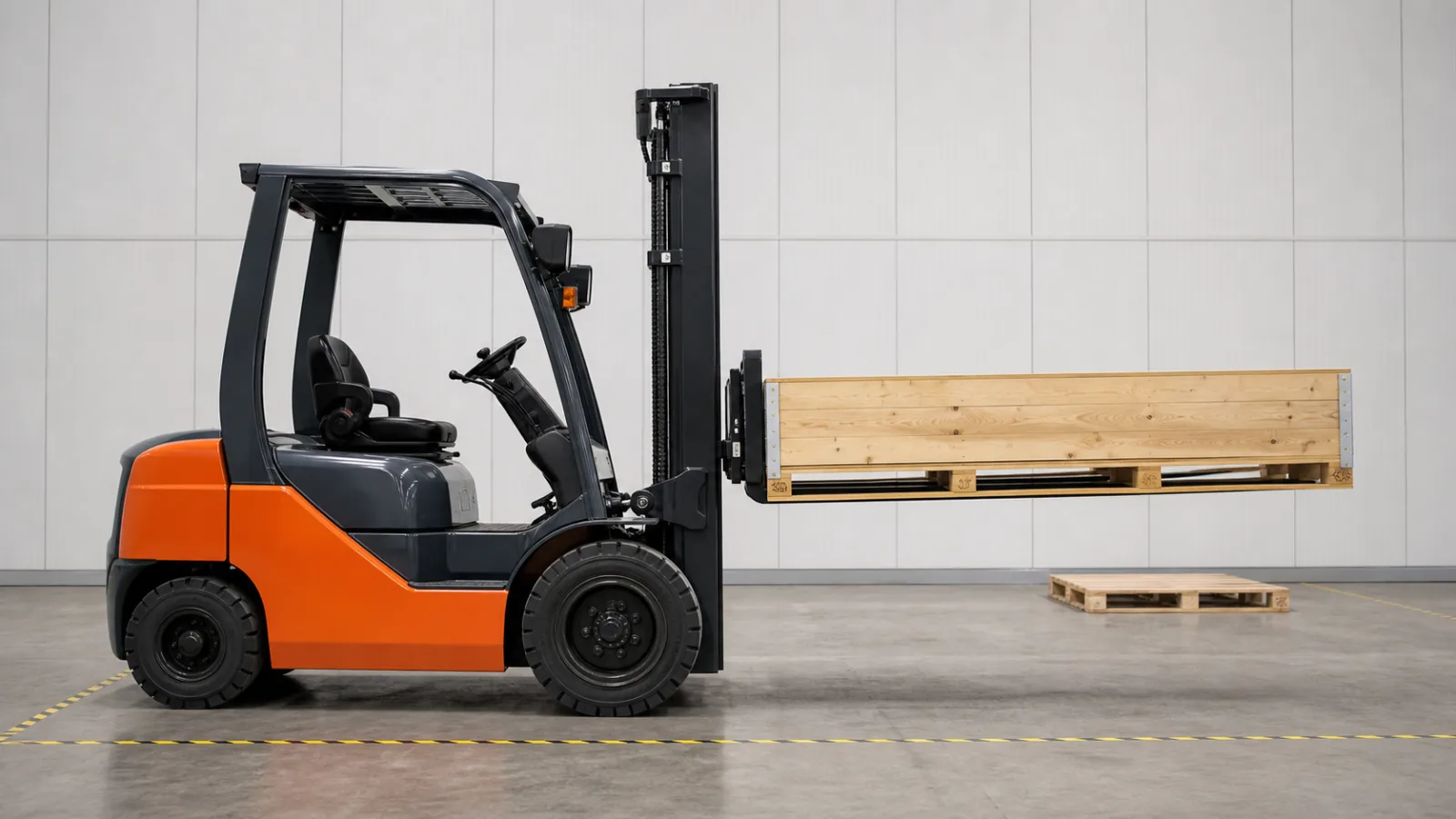
A forklift’s rated capacity applies only at a standard load centre — usually 500 mm. Move the load’s centre of gravity further from the forks and the safe capacity drops, which is why a “3-ton” truck may not lift 3 tons of a long or bulky load. This guide explains rated capacity, load centre and the load chart, and how to read them before you buy. HONGLI rates its forklifts at a 500 mm load centre (600 mm on 6–10 t models).
This article explains what rated capacity really promises, what a load centre is, and how to work out — before you order — what your truck will actually lift with your loads.
What rated capacity actually means
When a manufacturer rates a forklift at 3,000 kg, the full sentence is: *3,000 kg at a 500 mm load centre, on a standard mast, with standard forks.* Every part of that sentence is a condition. Change any condition — a longer load, an attachment, a taller mast — and the safe working load drops below the headline number.
The rating is not a safety margin you can eat into. It is the boundary of the machine’s stability and hydraulic design, set by the same physics that keeps the truck’s rear wheels on the ground.
What is a load centre?
The load centre is the horizontal distance from the vertical face of the forks to the center of gravity of the load. The industry standard rating point is 500 mm (24 inches in North American practice) — which assumes a uniform load about 1,000 mm deep, like a standard pallet, sitting tight against the carriage.
Here is a fact worth keeping as a sentence on its own: a forklift’s rated capacity applies only at its rated load centre; longer loads move the center of gravity outward and reduce what the truck can safely lift.
The physics, in plain words
A counterbalance forklift is a seesaw. The front axle is the pivot. The load on the forks sits on one side; the truck’s body and built-in counterweight sit on the other. As long as the counterweight side “wins,” the rear wheels stay planted and the truck steers and brakes normally.
Move the load’s center of gravity further out — a deeper crate, a load not pushed fully home, forks entered from the long side of a pallet — and the load’s side of the seesaw gains leverage without gaining a single kilogram. The truck does not know your load got longer. It only knows the rear wheels are getting light.
What de-rates a forklift’s capacity
Four things reduce effective capacity, and they stack:
- Longer or deeper loads. The most common case. Anything beyond the rated load centre — long crates, pipe, timber, machinery — reduces capacity, roughly in proportion to the extra distance.
- Attachments. Every attachment adds its own weight and usually pushes the load centre forward. A side shifter costs a little; a long clamp or extensions cost more. The truck’s data plate must be updated to show the combined rating.
- Lift height. Capacity at full height on a tall mast is lower than capacity at ground level. High-lift trucks carry a capacity chart, not a single number — read it at *your* beam height.
- Condition and tyres. Worn forks, the wrong tyres for the surface, and uneven ground all shave the practical margin further. The data plate assumes a sound truck on firm, level ground.
A worked example
Say you run a 3,000 kg truck rated at a 500 mm load centre, and your typical load is a 1,200 mm-deep crate, weight evenly spread. The load’s center of gravity sits at 600 mm — 100 mm beyond the rating point.
A widely used field approximation: effective capacity ≈ rated capacity × (rated load centre ÷ actual load centre). Here: 3,000 × (500 ÷ 600) = roughly 2,500 kg. Your “3-ton” truck is, for this crate, a 2.5-ton truck — before any attachment or height effect is counted.
Treat that formula as an estimate for planning, not a license: the binding numbers are the manufacturer’s capacity chart and the data plate for your exact configuration. Any serious supplier will calculate them for your case before you order — and put them in writing.
How to read a data plate and capacity chart
Every forklift carries a data plate (also called a capacity plate or nameplate), and it is the machine’s legal identity: model, serial number, service weight, and rated capacity at stated load centres and lift heights. Two habits separate professional operations from lucky ones.
First, read the plate against the job, not against the brochure. If the plate says 3,000 kg at 500 mm up to 4,000 mm lift, and your load is deeper or your beam is higher, the headline number is not your number — the chart’s lower figure is.
Second, keep the plate current. The moment an attachment is fitted, the original rating is obsolete; reputable suppliers issue a revised plate or chart for the combination. A truck running an attachment on its original plate is not just a paperwork problem — in most markets it is a compliance failure your insurer will notice exactly once, at the worst possible time.
When you buy, ask the factory for the capacity chart for your exact configuration in writing before the deposit. It takes a manufacturer minutes to produce and tells you more than any sales page.
How to order the right truck the first time
Give your supplier the real worst case, not the average day:
- Your heaviest load, not your typical one.
- Its dimensions and how you pick it up — fork entry side changes the load centre.
- Your highest set-down point, measured, plus clearance.
- Any attachment you plan to fit, now or later.
- The ground: indoor concrete, yard gravel, ramps.
With those five facts, a manufacturer can spec a truck that lifts your load at your height with margin to spare — and tell you honestly when the answer is the next capacity class up. At Hongli Machinery this calculation is part of every quote; capacities across the range run from 1.0 to 16.0 tons, so the right class exists.
FAQ
What does a 500 mm load centre mean?
It means the forklift’s rated capacity assumes the load’s center of gravity sits 500 mm from the vertical face of the forks — roughly the midpoint of a standard 1,000 mm-deep pallet load.
Can I lift a load heavier than the forklift’s rated capacity?
No — the rating is a stability and design limit, not a suggestion; exceeding it risks tipping the truck forward, and it also voids warranties and breaks workplace safety rules in most markets.
Do fork extensions change the load centre?
Yes — extensions exist precisely to carry longer loads, which places the center of gravity further out and lowers the truck’s working capacity; always get the de-rated figure for your combination before using them.
Why do taller masts reduce capacity?
Because a load carried high raises the whole system’s center of gravity and the mast itself flexes more at height, so stability shrinks as the forks rise; that is why high-lift trucks publish a capacity chart by height rather than one number, and why your highest beam — not your heaviest load alone — can be the spec that decides which truck you need.
Is it safe to add extra counterweight to lift more?
No — adding weight to the rear overloads the steer axle, hides the early warning signs of forward tip, and exceeds the chassis, brake and hydraulic design limits; if your loads outgrow the truck, the safe answer is the next capacity class, not improvised ballast.