
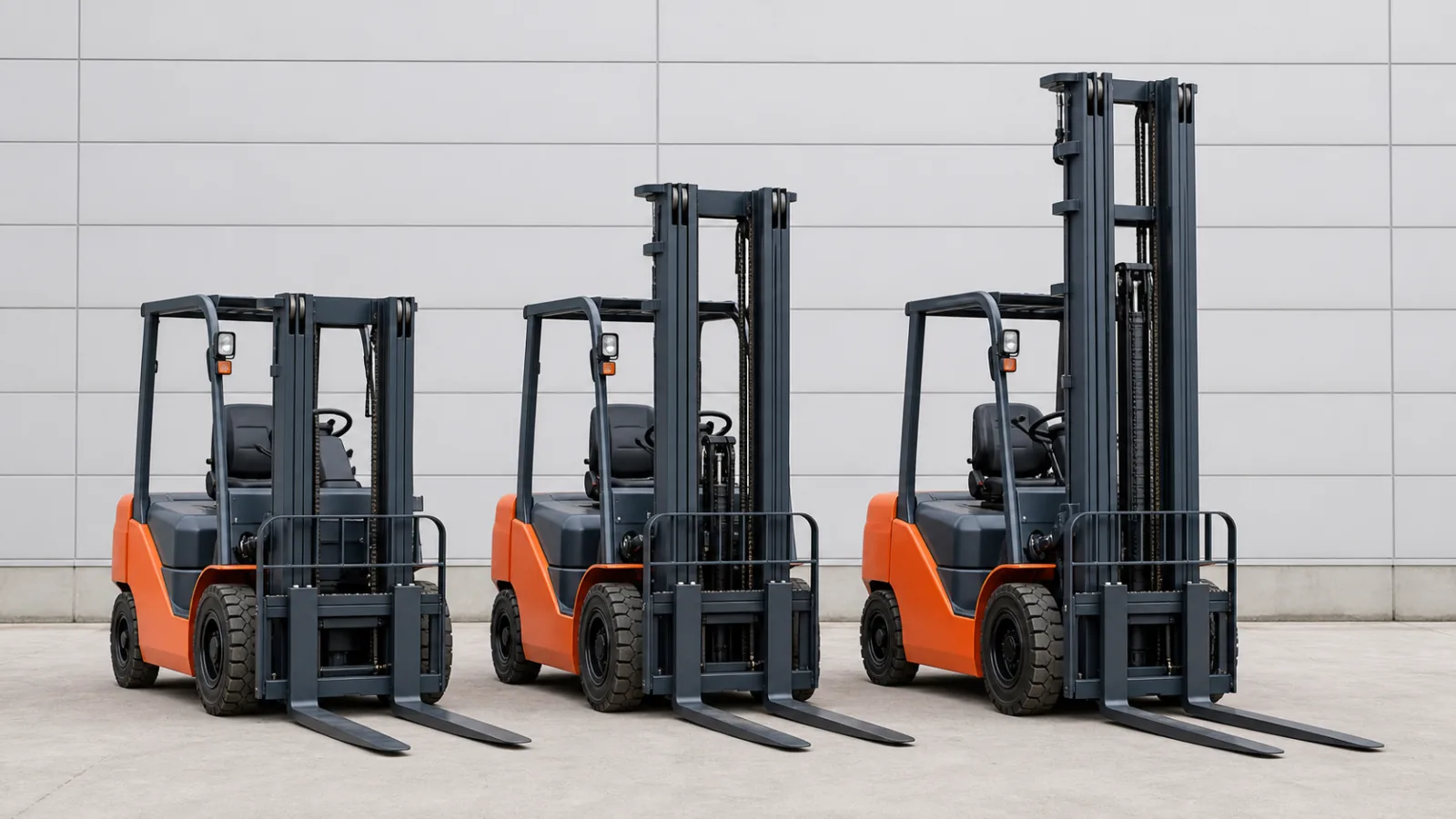
Forklift masts come in three main types. A two-stage (duplex) mast is simple and strong for general yard and warehouse work. A three-stage (triplex) mast reaches higher in the same closed height — useful under low doors with tall racking. A full-free-lift mast raises the forks without raising the mast, for stacking inside containers and low ceilings. This guide explains each type, the difference between lift height and free lift, and how to match a mast to your doorway and top beam. HONGLI forklifts ship with a 3 m two-stage mast as standard, with taller and free-lift options on request.
Get a Quote · Chat on WhatsApp
FAQ
Two-stage vs three-stage — what’s the difference?
A two-stage (duplex) mast has two channels and one telescoping section; a three-stage (triplex) mast adds a third, so it reaches higher from the same closed height. Pick two-stage for general yard and warehouse work, and three-stage when you must clear tall racking but still fit under a low door.
What is free lift?
Free lift is how far the forks rise before the mast itself starts to extend. A standard mast has little free lift; a full-free-lift mast raises the forks to near the top of the closed mast first, so you can stack inside a container or under a low ceiling without the mast hitting it.
Which mast for container loading?
A full-free-lift mast, because it raises a full load inside a 2.3 m container without extending the mast through the roof. A standard two- or three-stage mast grows as it lifts, so it cannot work the top of a container.
What mast does HONGLI fit as standard?
HONGLI forklifts ship with a 3 m two-stage mast as standard. Taller three-stage and full-free-lift masts are available on request — send your lift height and door height and we spec the mast to match.