
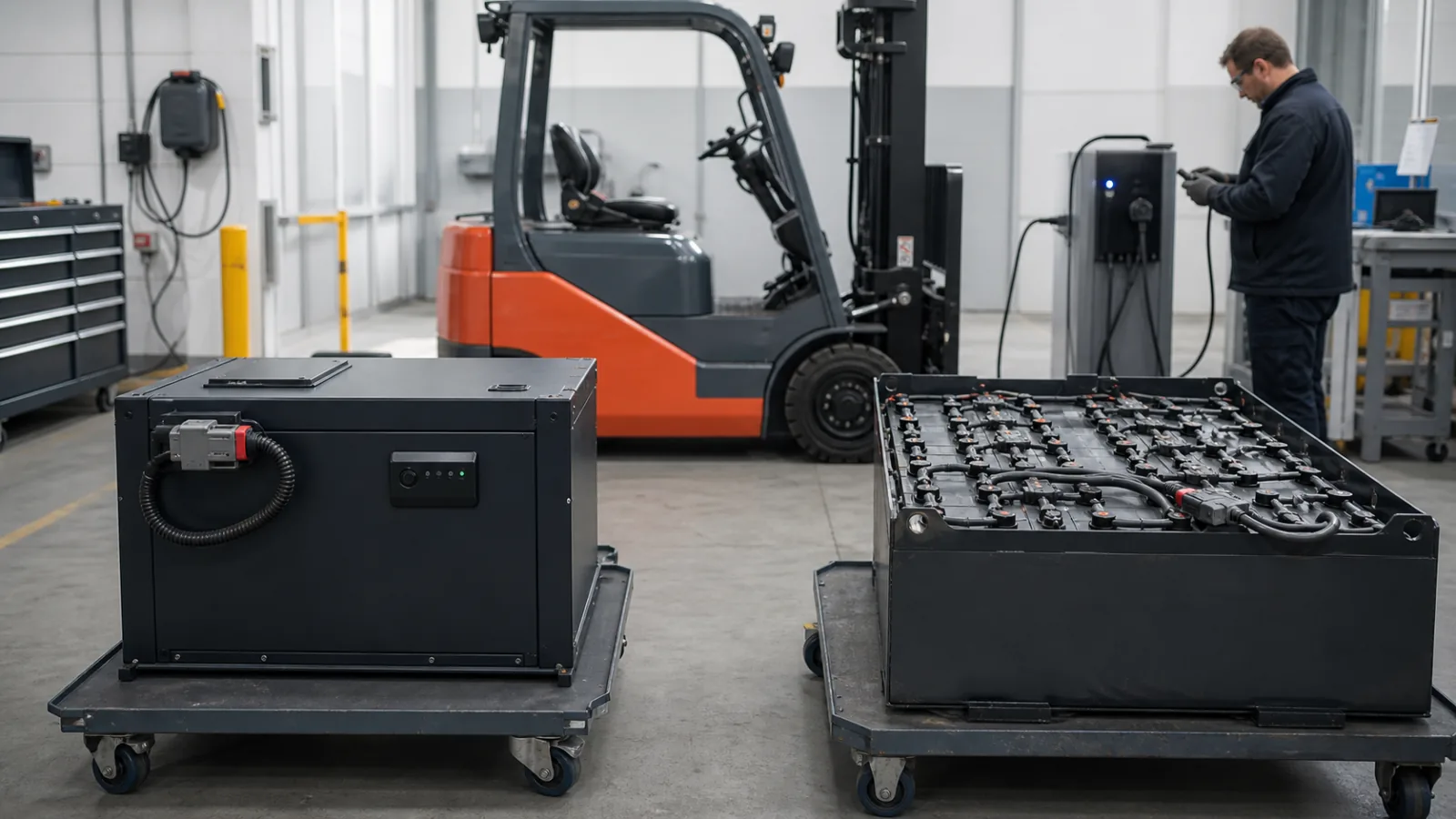
Lead-acid batteries cost less up front and suit single-shift work; lithium costs more but charges faster, lasts longer and needs no watering — paying back on multi-shift or opportunity-charging duty. This guide compares price, charge time, lifespan and maintenance, and shows when each wins. HONGLI’s electric forklifts ship with a 60–72V lead-acid pack as standard, with a lithium upgrade optional — tell us your shift pattern and we will quote the right one.
Every Hongli electric forklift, from the 1-ton HLCPD10 to the 5-ton HLCPD50, ships with your choice of either chemistry — so we have no stake in which you pick beyond it being right for your operation. Here is the comparison in plain terms.
The five-line comparison
| Lead-acid | Lithium (LiFePO4) | |
|---|---|---|
| Upfront cost | Lower — the budget-friendly entry | Higher, commonly a noticeable premium per truck |
| Charging | Full charge plus cooling; wants a dedicated window | Opportunity charging in breaks; no cooling wait |
| Cycle life | Roughly 1,000–1,500 cycles with good care | Roughly 2,000–4,000 cycles, chemistry and care depending |
| Maintenance | Watering, equalizing charges, terminal cleaning | Effectively none |
| Handling | Battery rooms, acid precautions, ventilation | Sealed packs; charge where the truck parks |
Ranges are industry-typical figures for planning; the binding numbers come with the specific battery quoted for your truck.
Charging is the real difference
A lead-acid battery wants to be charged fully, in one sitting, and then to cool — interrupt that routine with partial “convenience” charges and you shorten its life. Practically, that means a charging window of several hours, every day, forever. One shift with quiet nights? No problem. Two or three shifts, and the lead-acid playbook becomes spare batteries: a second pack per truck, a changing station, lifting equipment and someone whose job includes swapping them. All of that works — fleets ran decades on it — but every piece of it is cost.
Lithium inverts the logic. It tolerates partial charging happily, so the truck sips power during breaks — fifteen minutes here, a lunch half-hour there — and finishes the day without ever leaving service. No spare pack, no changing station, no battery room. That single property is why multi-shift operations have moved to lithium almost as a bloc.
Maintenance and safety, honestly stated
Lead-acid is a chemistry you tend: water levels checked and topped with distilled water, periodic equalizing charges, terminals kept clean, and charging done in ventilated space because charging emits hydrogen and the electrolyte is acid. None of this is hard, all of it is discipline — and skipped discipline is the leading killer of lead-acid batteries and their warranties.
Lithium asks for almost none of that: sealed packs, no watering, no equalizing, no acid handling, no dedicated ventilation requirement for normal charging. The battery management system does the supervising. The honest counterweight: when something does go wrong with a lithium pack it is a component-replacement conversation rather than a maintenance one — which is a reason to buy from a supplier whose parts supply you trust.
Lifespan and the total-cost math
Count cycles, not years. At 1,000–1,500 cycles, a lead-acid pack in single-shift service lives respectably; push it harder and replacement day arrives sooner, and a replacement pack is a four-figure event. Lithium’s 2,000–4,000 cycles commonly outlast one lead-acid replacement and sometimes two — meaning the upfront premium buys back a future battery purchase, the maintenance hours, and (for multi-shift fleets) the entire spare-battery apparatus.
The crossover arithmetic mirrors our electric-vs-diesel sums : heavy use repays the premium quickly, light use slowly or never. A truck working 300 hours a year should buy lead-acid and bank the difference; a truck working 2,000 hours across two shifts should price lithium first and ask lead-acid to argue its way back in.
Two details the spec sheets skip
Weight is a feature. A counterbalance forklift needs its battery’s mass — the battery is part of the counterweight. This is why lithium packs for forklifts are built up to a specified service weight rather than made as light as possible, and why battery chemistry is a configuration decision at the factory, not an accessory choice afterwards. It is also why a casual chemistry swap later is more involved than it sounds: change the pack’s weight and you have changed the truck’s stability math.
Chargers are part of the quote. Each chemistry brings its own charging hardware, and the cost difference between a basic lead-acid charger and a lithium fast-charging setup belongs in your comparison. So does electrical capacity: several trucks opportunity-charging through breaks draw meaningful power at once, and an older warehouse’s supply may need checking before a large fleet converts. None of this changes the answer for most buyers; all of it belongs on the table before the order, which is why we quote battery, charger and truck as one configuration rather than three line items you assemble yourself.
One shift, two shifts, three — the answers
- Single shift, charging overnight: lead-acid is the value answer; lithium is a comfort upgrade, not a financial one.
- Two shifts: the tipping zone. Price both; lithium usually wins once a spare lead-acid pack enters the quote.
- Three shifts / round-the-clock: lithium with planned opportunity charging, and the comparison is rarely close. (此结论与制造业行业页FAQ口径一致)
- Cold storage: battery heating options matter as much as chemistry — see our cold store page; all three cold-store options are available on Hongli electrics.
- Rental fleets: a special case worth naming — rental machines meet unpredictable duty in unknown hands, and lithium’s indifference to charging discipline removes the most common way renters kill lead-acid batteries. The premium often pays for itself in batteries that survive their customers.
How this works when you order from Hongli
Every electric model in our range — HLCPD10 through HLCPD50, with packs from 60V/120Ah to 80V/500Ah — is available in lithium or lead-acid. You choose at order time; the quote shows both if you ask, which costs nothing and settles the debate with numbers instead of opinions. Reply within one working day.
FAQ
How much more does a lithium forklift battery cost?
Lithium carries a meaningful upfront premium over lead-acid, varying by pack size and market — but at multi-shift usage it typically repays the difference through longer cycle life, zero maintenance and the spare battery it makes unnecessary.
How long does a lead-acid forklift battery last?
Roughly 1,000–1,500 charge cycles with disciplined care — full charges, regular watering and equalizing — which translates to about five years in single-shift service and proportionally less when worked harder.
Can I switch a forklift from lead-acid to lithium later?
Sometimes, but it is not a simple swap — weight distribution, charger and battery management must all match, so the conversion needs the manufacturer’s confirmation; choosing the chemistry at order time is the clean path.
Do lithium forklift batteries work in cold storage?
Cold reduces every battery’s output, lithium included, so cold store work is configured rather than assumed: battery heating, low-temperature hydraulic fluid and condensation-protected electrics are the package to specify — all three are available on Hongli electric models.
Can I run a mixed fleet of lithium and lead-acid trucks?
Yes, and fleets in transition often do — the practical requirements are separate chargers per chemistry and clear labeling so operators never put a truck on the wrong charger; many buyers convert the multi-shift trucks to lithium first and let single-shift units finish their lead-acid batteries’ lives.