
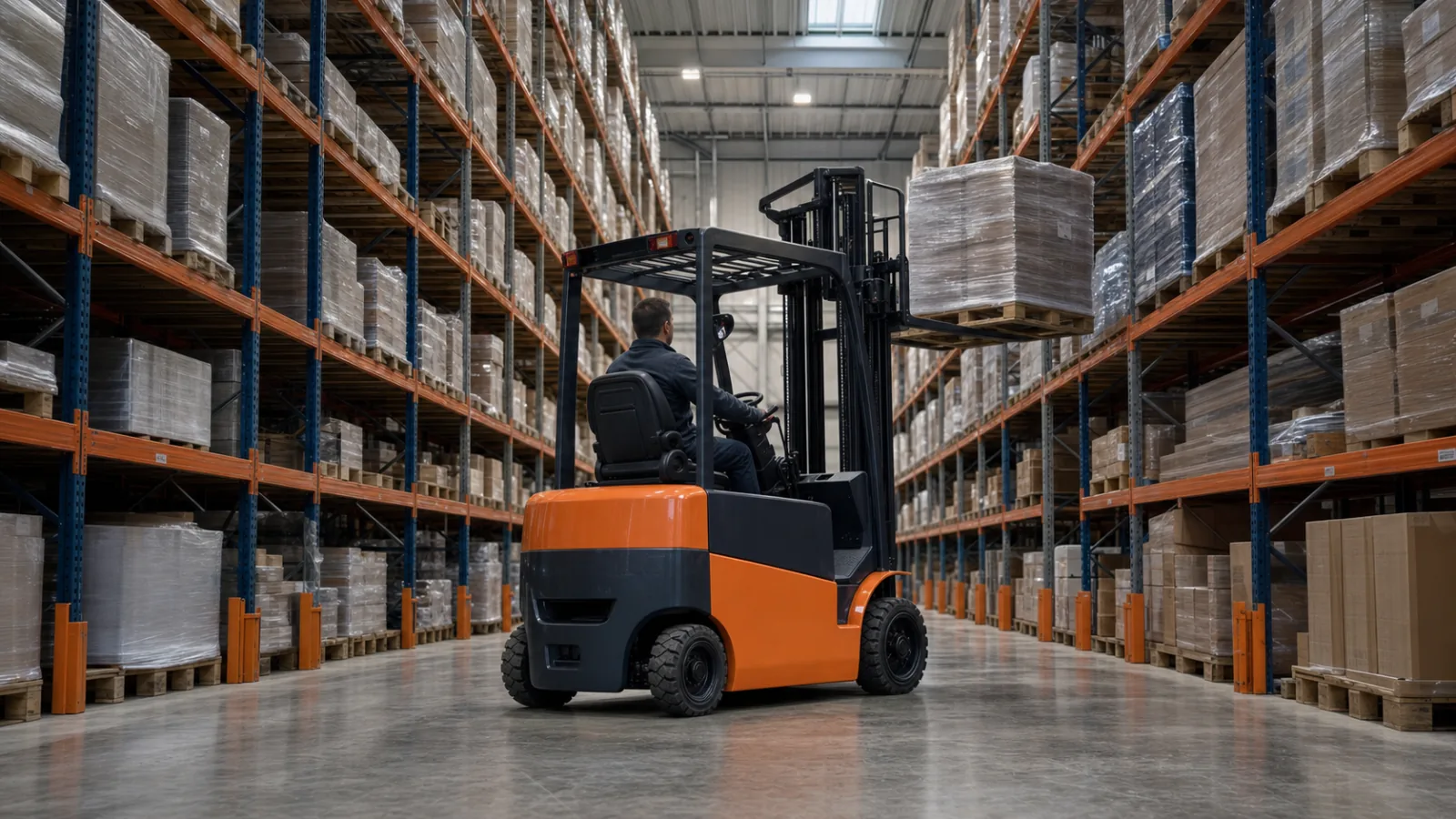
The right warehouse forklift comes down to five things: aisle width, rack height, floor surface, power type and shift pattern. Narrow aisles favour three-wheel or reach trucks; high racking needs the right mast; indoor air rules out exhaust. This guide walks each decision and turns it into a spec. For most warehouses, a HONGLI electric counterbalance (1–5 t) or three-wheel forklift (down to a 1,660 mm turn) on 60–72V AC fits — send your layout for a recommendation.
Decision 1 — Capacity: your heaviest load, at its load centre
Start with the heaviest load the truck will ever lift, not the typical one. Then check its dimensions, because rated capacity assumes a standard load centre (500 mm) — a deeper crate or a load picked up from the long side moves the center of gravity out and cuts what the truck can safely lift, sometimes by hundreds of kilograms. The full physics is in our load centre guide ; the working rule is simple: spec for the worst case with margin, and have the supplier confirm the effective capacity for your actual loads in writing.
The common mistake: buying for the average pallet, then meeting the quarterly delivery of machinery crates that the truck cannot touch. The truck did not fail; the specification did.
Decision 2 — Lift height: measure, don’t guess
Walk to your tallest rack, measure the top beam, add clearance for the load and the operation, and that is your lift height. Hongli’s standard masts lift to 3,000 mm, which covers a great deal of general warehousing; taller racking takes alternative mast options, quoted per order.
Two costs hide in this decision. Taller masts cost more to buy — and they cost capacity, because trucks lift less at height than at the floor (the capacity chart by height is the document to read, not the headline number). Buying lift height “to be safe” is therefore the most quietly expensive habit in forklift purchasing.
The common mistake: the reverse error also appears — re-racking the warehouse a year after buying trucks specced to the old beams. If a racking change is on your roadmap, spec to the future building, not the current one.
Decision 3 — Aisle width: the building votes too
A counterbalance forklift needs room to turn a pallet into racking — for typical trucks, a working aisle of roughly 3.5–4 m, depending on the model’s turning radius and your pallet size. Measure your narrowest working aisle before shortlisting models, and have the supplier confirm the right-angle stacking aisle for the specific truck against your pallet dimensions.
If the aisles are tight, look at compact models before exotic ones: the smaller trucks in a counterbalance range — our HLCPD10 and HLCPD15 run body widths of 1,020–1,096 mm — work tighter layouts than buyers expect. If the aisles are genuinely narrow by design, that is a different machine class and a different conversation; say so in the inquiry rather than forcing a counterbalance truck where it cannot turn.
The common mistake: choosing the truck first and discovering the aisles second. The building is the one part of the system you cannot re-spec at order time.
Decision 4 — Power: electric by default, with two honest exceptions
For indoor warehouse work, electric is the default answer in 2026: no exhaust, the lowest running cost per hour, and the least maintenance. The real choice inside “electric” is the battery — lithium accepts opportunity charging during breaks and covers multi-shift patterns; lead-acid costs less upfront and suits single shifts with overnight charging. All Hongli electric models offer both; choose at order time.
The two exceptions: trucks that also work the yard all day, where LPG’s minutes-long tank swap earns its place ; and genuinely outdoor, rough-ground duty, which is diesel territory and probably means your “warehouse forklift” is really two different machines. Buying one truck to do both jobs badly is a false economy that two right-sized trucks usually beat.
The common mistake: letting charging fears push the purchase to combustion without pricing lithium first. The fear is usually five years out of date.
Decision 5 — Tyres and floors
Smooth concrete indoors: cushion or solid tyres, and non-marking compounds where floor appearance or food-grade rules matter. Mixed indoor-yard duty: pneumatic or solid pneumatics that tolerate debris and dock plates. Tyres are the cheapest line on the spec sheet and the most ignored — and the wrong ones mark floors, jar loads and shorten the truck’s life on rough surfaces.
The common mistake: forgetting the dock. If the truck crosses dock plates and the occasional pothole at the loading bay, spec for that reality, not for the smooth 95% of its day.
A worked example, start to finish
Suppose a distribution warehouse: heaviest load 2,800 kg on standard 1,000 mm pallets, top beam at 2,800 mm, narrowest working aisle 3.8 m, two shifts, indoor only with smooth concrete, food-adjacent so no exhaust and no tyre marks.
Walk the five decisions. Capacity: 2,800 kg at a standard load centre points to the 3-ton class with sensible margin — an HLCPD30. Lift height: the 3,000 mm standard mast clears the 2,800 mm beam with room to operate. Aisle: 3.8 m suits a 3-ton counterbalance truck’s right-angle stacking — confirmed against the model’s turning radius at quote time. Power: indoor, two shifts, food-adjacent — electric, and the two-shift pattern argues for lithium with break-time opportunity charging over a lead-acid spare-battery routine. Tyres: non-marking solids for the floor and the food rules.
Ten minutes of measuring produced a complete, quotable specification — one truck, one battery choice, one tyre spec, nothing left for the supplier to guess. That is the entire method. The same ten minutes spent after delivery instead of before it is called regret.
The one-page requirement list
Send a supplier these ten lines and you will get an accurate quote on the first pass:
1. Heaviest load (kg) and its dimensions
2. How the load is picked up (pallet type, entry side)
3. Top beam height (mm)
4. Narrowest working aisle (mm)
5. Shifts per day and hours per shift
6. Indoor only, or indoor plus yard?
7. Floor type and condition
8. Any special environment (cold store, food, dust)
9. Quantity, now and in the next year
10. Destination port
At Hongli Machinery that list comes back within one working day as matching models, full specifications and FOB pricing.
FAQ
What size forklift do most warehouses use?
Most general warehouses run 2–3.5 ton electric counterbalance forklifts; the deciding specs are the heaviest pallet, the top beam height and the narrowest working aisle, in that order.
Should a warehouse forklift be electric or LPG?
Electric, unless the truck also works outdoors for serious parts of its shift or charging genuinely cannot be scheduled — in which case compare LPG before deciding.
How wide do aisles need to be for a counterbalance forklift?
Typically around 3.5–4 m working aisle for right-angle stacking, varying by model turning radius and pallet size — confirm the figure for the specific truck against your pallet dimensions before ordering.
Is it better to buy one bigger forklift or two smaller ones?
Two right-sized trucks usually beat one oversized truck: a 5-ton machine doing 2-ton work costs more to buy and run, stresses floors and aisles it was never measured against, and leaves the whole operation idle when it goes down for service — whereas two trucks give you redundancy and let each work where it fits. Size the fleet to the work, not to the single heaviest day; for that one heavy day, factor a rental or a deliberate heavy unit into the plan instead of inflating every machine you own.