
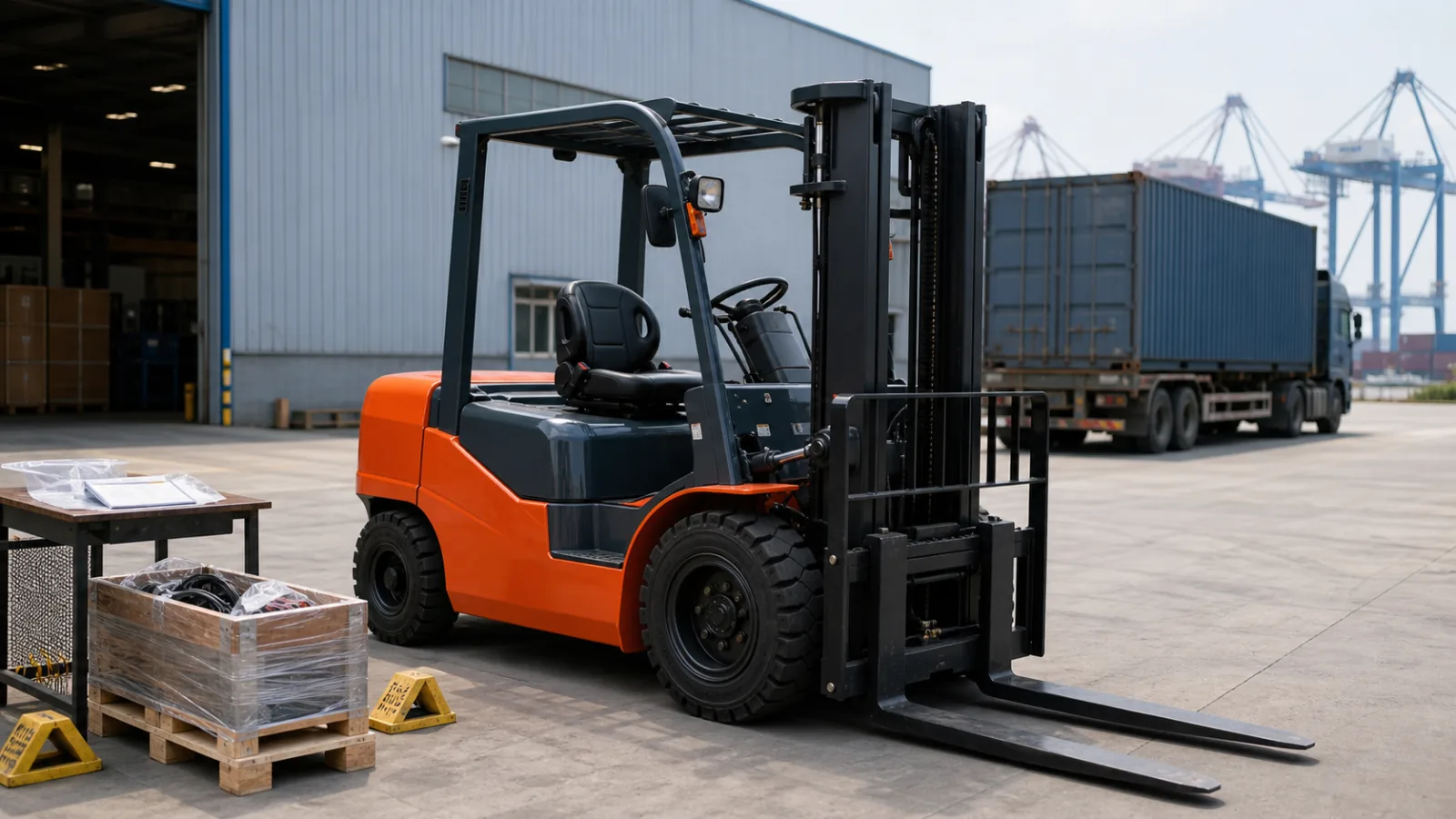
A China forklift’s landed cost is the FOB factory price plus sea freight, import duty, clearance and inland delivery. The FOB price is only the start — this guide shows how each component adds up for a typical container, how SKD/CKD kits can lower freight and duty, and what documents you need. HONGLI quotes FOB factory-direct, so you can add your own freight and duty to compare against fully-landed local pricing.
(For what the machines themselves cost, our forklift price guide covers FOB ranges by type and class.
Layer 1 — The FOB price
FOB (“Free On Board”) means the factory’s price covers the machine, packed and loaded onto the vessel at the Chinese port — Qingdao, for Hongli machines. Everything before the ship’s rail is the factory’s problem; everything after is yours. This is the price quoted in most factory negotiations and the baseline for all the math below. Make sure the FOB quote itemizes options, because “the machine” and “the machine you actually specced” can differ by four figures.
Layer 2 — Sea freight
Freight is priced per container, not per machine, which makes your loading plan a pricing decision. A 20GP container takes two HLCPC20 2-ton diesel forklifts, so the container’s freight cost splits two ways; ship one machine in the same box and that single unit carries the whole fare. Container rates move with the shipping market and your route — they have swung by multiples within recent memory — so treat any number you read as a placeholder and get a live quote from a forwarder. As a rough planning anchor, a single container’s freight on major routes typically lands in the low-to-mid four figures in USD; your forwarder’s quote is the truth.
This is also where mixed containers earn their keep: forklifts, loaders and attachments sharing one box from one factory means freight spread across more revenue-earning machines.
Layer 3 — Insurance
Marine cargo insurance is the cheap line on this list — typically a fraction of one percent of cargo value — and skipping it is the false economy veterans warn about. If you buy CIF, the factory arranges minimum cover to your port; check whether “minimum” satisfies you, and remember risk still transfers at loading. (Incoterms in plain words: our import guide.
Layer 4 — Duties and taxes
The layer that varies most by market. Forklifts generally classify under HS heading 8427; the duty rate that heading carries depends on your country and its trade agreements with China — anywhere from zero to double digits. On top of duty, most markets apply VAT or GST on the landed value. Two practical notes: first, confirm the HS code and rate with a local customs broker before ordering, not after the container lands; second, in many countries VAT/GST paid at import is recoverable for registered businesses through normal tax filings — meaning the headline tax is a cash-flow item rather than a true cost. Your accountant will confirm what applies to you.
Layer 5 — The local mile
The costs importers most often forget live after customs: port handling and terminal fees, customs brokerage, inland trucking to your site, unloading at delivery, and any local compliance — registration, inspection or operator requirements your market applies to industrial trucks. None is large alone; together they deserve a real line in the budget. So does currency: if your business runs in euros or another currency, the USD invoice carries exchange exposure between deposit and balance — 30% T/T with order and 70% before shipment is the standard rhythm at Hongli, so you know exactly when each payment falls.
A worked example to hang numbers on
Illustrative only — your quotes will differ. Take two 3-ton diesel forklifts at, say, $13,000 FOB each, sharing a 20GP container. Freight at $3,000 splits to $1,500 per machine; insurance adds perhaps $40 each. In a market charging 5% duty, that is roughly $730 per machine; add VAT at 15% on the landed value (recoverable for many businesses), and the cash-out before local costs sits near $17,000 per unit — with port, brokerage and trucking taking it to the high seventeens. Landed, that remains far below the $30,000–45,000 a comparable Western-brand truck commands locally — which is the arithmetic the whole import exercise exists to capture.
Part-container, full container, mixed container
Because freight, handling and brokerage are largely per-container costs, the per-machine overhead falls as the box fills — which quietly reshapes purchasing decisions. A buyer who needs one forklift today and will need another within a year often does better importing both now: the second machine rides on freight already paid. Dealers take this logic to its end with mixed containers — forklifts, loaders and attachments from one factory in one box — so every shipment carries a full spread of sellable stock instead of one product line. If your order does not fill a container, ask the factory about consolidation options before paying solo freight on half-empty space; the answer is sometimes worth more than any discount you could negotiate on the machine itself.
A budget template you can copy
For each machine, build the landed cost in seven lines and you will not be surprised: (1) FOB price per the itemized quote; (2) your share of container freight, from a live forwarder rate; (3) marine insurance at a fraction of a percent; (4) duty at your broker’s confirmed rate on the customs value; (5) VAT/GST on the landed value, marked recoverable or not per your accountant; (6) port, handling and brokerage fees; (7) inland trucking and unloading. Sum lines 1–4 and 6–7 for true cost; add line 5 for cash-flow planning. Run the template once and it serves every future order — the only inputs that change are the FOB price and the freight market.
How to get your real number
Five requests, one afternoon: the factory’s FOB and CIF quotes (compare both); your forwarder’s live freight rate; your broker’s confirmed HS code and duty rate; your accountant’s word on VAT recovery; and your own list of local fees from the last container you imported, or a broker’s estimate if this is your first. At Hongli the factory side of that list comes back within one working day.
FAQ
How much does it cost to ship a forklift from China?
Freight is priced per container rather than per machine — a 20GP holds two 2-ton forklifts, so each carries half the container rate; get a live quote from a forwarder, as rates move with the shipping market.
What import duty applies to forklifts?
Forklifts generally fall under HS heading 8427, with duty ranging from zero to double digits depending on your country’s tariff schedule and trade agreements with China — confirm with a local customs broker before ordering.
Is the VAT on an imported forklift recoverable?
In many countries, yes — registered businesses recover import VAT/GST through normal tax filings, making it a cash-flow cost rather than a true one; confirm your market’s rules with your accountant.
Is CIF or FOB cheaper when importing forklifts?
Neither is inherently cheaper — CIF bundles the freight into the factory’s price while FOB lets your own forwarder compete for it; importers with good freight rates usually do better on FOB, first-timers often prefer CIF’s single number, and asking for both quotes costs nothing.