
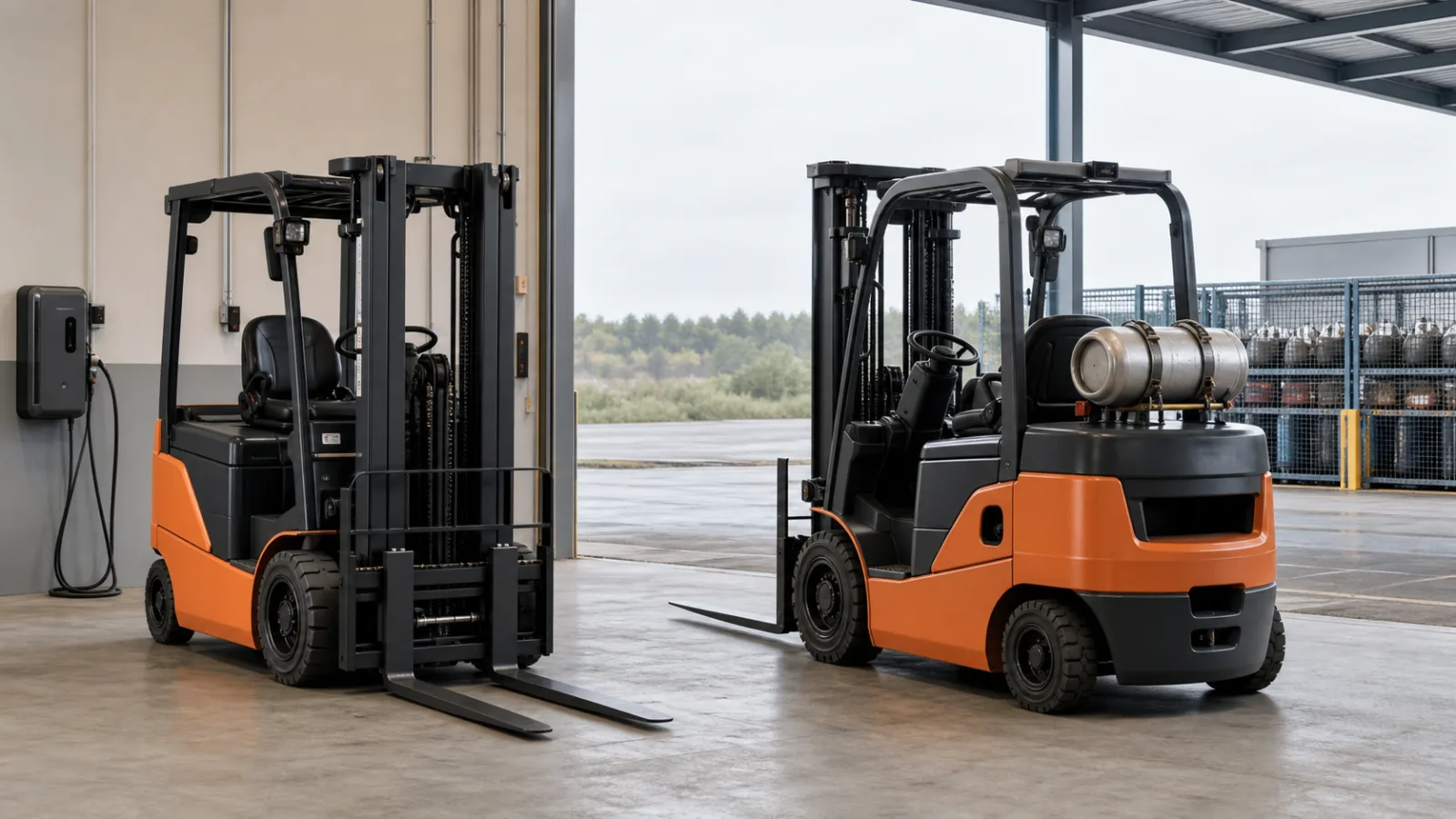
LPG forklifts refuel in minutes and run indoors or out, but cost more per hour and emit exhaust; electric forklifts are cleaner and cheaper to run but need charging time and space. This guide compares the two fairly on refuelling, running cost, indoor air quality, power and lifespan. Note: HONGLI builds electric (and diesel) forklifts, not LPG — so if you compare and prefer electric, we can quote a 60–72V model factory-direct.
Hongli Machinery builds electric forklifts as standard models and configures LPG power to order, so we sell both answers. What follows is the comparison as we walk buyers through it, including the parts each side’s salespeople tend to skip.
The one-question shortcut
Where does the truck spend its day? Count the hours, not the impressions. A truck that does forty minutes of yard work and seven hours of aisle work is an indoor truck with an errand, and electric handles rain on firm ground without complaint. A truck that genuinely splits its shift between dock, yard and warehouse — loading vehicles outside, feeding racking inside — is the machine LPG was made for: one power source that works in both worlds without a charging schedule to manage.
Refueling vs charging — the operational difference
This is the comparison’s real hinge. An LPG tank swaps in minutes: lift off the empty, drop on the full, work continues. There is no infrastructure beyond tank storage and a supply contract with a local gas vendor.
Electric used to lose this argument badly, because a lead-acid battery wants hours to charge plus cooling time, which means either a charging window or the cost and handling of spare batteries. Lithium changed the arithmetic: it accepts opportunity charging — fifteen minutes during a break, half an hour at lunch — and covers multi-shift patterns without a battery change. All Hongli electric models offer the lithium option, which is worth knowing before you let charging logistics decide your purchase.
So the honest framing: against lead-acid electric, LPG wins on uptime convincingly. Against lithium with planned opportunity charging, the gap narrows to operations that truly cannot schedule any pause at all.
Costs, line by line
- Purchase price. An LPG truck usually costs less upfront than the same-capacity electric once the battery is counted, and more than the same-capacity diesel. Lithium widens the electric premium; lead-acid narrows it.
- Energy. Electricity per operating hour costs well below LPG. Over a multi-year, full-shift life, energy alone usually repays electric’s purchase premium — the same arithmetic as our electric-vs-diesel comparison, slightly gentler because LPG burns cleaner and cheaper than diesel in many markets.
- Maintenance. An LPG truck has an engine: oil, filters, plugs, coolant, exhaust. An electric truck has none of that. Engine maintenance is routine and well understood, but it never stops costing.
- Fuel logistics. LPG adds a running dependency: tank deliveries, storage compliance, price exposure to your local gas market. Electricity arrives by wire at a price you already know.
The pattern repeats across power-source comparisons: combustion wins the purchase order, electric wins the years that follow. The question is whether your duty cycle gives electric enough hours to collect.
Indoor air — what ventilation can and cannot do
LPG burns much cleaner than diesel, which is why LPG trucks are accepted for indoor work where diesel is not. But clean-er is not clean: an LPG engine still produces carbon monoxide, and indoor LPG operation depends on adequate ventilation, maintained engines and sensible workspace design. In poorly ventilated corners, CO accumulates — and CO is invisible, odorless and serious.
Two practical rules. First, if the space is enclosed and ventilation is marginal, choose electric and stop debating. Second, some industries make the decision for you: food processing, pharmaceuticals and cleanroom-adjacent work generally specify electric regardless, because exhaust of any kind near product is a non-starter.
Performance and weather
In daily pallet work the two feel similar; modern electric motors give nothing away in responsiveness, and an engine’s steady power suits long outdoor runs. LPG tolerates rough yard life the way any engine truck does. Electric handles weather better than its reputation — rain on firm ground is fine for properly rated trucks — but a truck that lives outdoors in mud argues for combustion, and at that point usually diesel rather than LPG.
Resale and the direction of regulation
Worth a paragraph before you decide, because you will sell this truck one day. Emissions and indoor air rules tighten in one direction only, and urban operations face growing pressure on combustion equipment of every kind. An LPG truck bought today will work fine for its first owner; its second-hand market, in regulated regions, is the part that shrinks. Electric trucks increasingly hold value better in those markets — and a lithium-equipped truck with a documented battery history is becoming the used market’s preferred listing. None of this overrides a duty cycle that genuinely needs LPG; it just belongs in the total cost picture alongside fuel and filters.
A worked sketch to make the running costs concrete: a 2.5-ton truck working 1,600 hours a year burns LPG worth several dollars per hour; the same truck on electricity draws a fraction of that. Take a conservative $2–4 per hour gap and the energy difference alone is $3,000–6,000 a year, before engine servicing is counted. Against a lithium premium of a few thousand dollars, the crossover usually lands inside two years — sooner on multi-shift patterns, later or never below a few hundred hours a year. Your local gas and electricity prices move the line; ten minutes with last quarter’s utility bills will place it for your operation.
The decision checklist
Choose electric if most of these are true: the truck works mostly indoors; air quality matters (food, pharma, enclosed spaces); you can schedule charging or will spec lithium; you keep machines long enough for running costs to dominate.
Choose LPG if these are true: the truck crosses indoor-outdoor duty daily; no charging window exists and lithium opportunity charging still cannot cover the pattern; a reliable local LPG supply is in place; ventilation in your indoor areas is genuinely adequate.
How this works at Hongli
Our electric line runs HLCPD10 through HLCPD50 — 1.0 to 5.0 tons, lithium or lead-acid, your choice at order time. LPG is configured to order on our counterbalance platforms as part of the same engine-options program that covers EU Stage V and EPA diesel variants. Tell us your duty pattern and market, and we will quote both and let the numbers argue. Reply within one working day.
FAQ
Can an LPG forklift work indoors?
Yes, with adequate ventilation — LPG burns far cleaner than diesel, which is why it is the accepted engine option for indoor-outdoor work; in enclosed or poorly ventilated spaces, electric remains the safe choice.
Is LPG cheaper than electric to run?
No — per operating hour, electricity costs substantially less than LPG and the electric truck carries no engine maintenance; LPG’s advantages are upfront price and minutes-long refueling, not running cost.
How long does an LPG tank last?
Typically around a full shift for a standard tank on a mid-size counterbalance truck, varying with truck size and workload — and swapping the tank takes minutes, which is the point.