
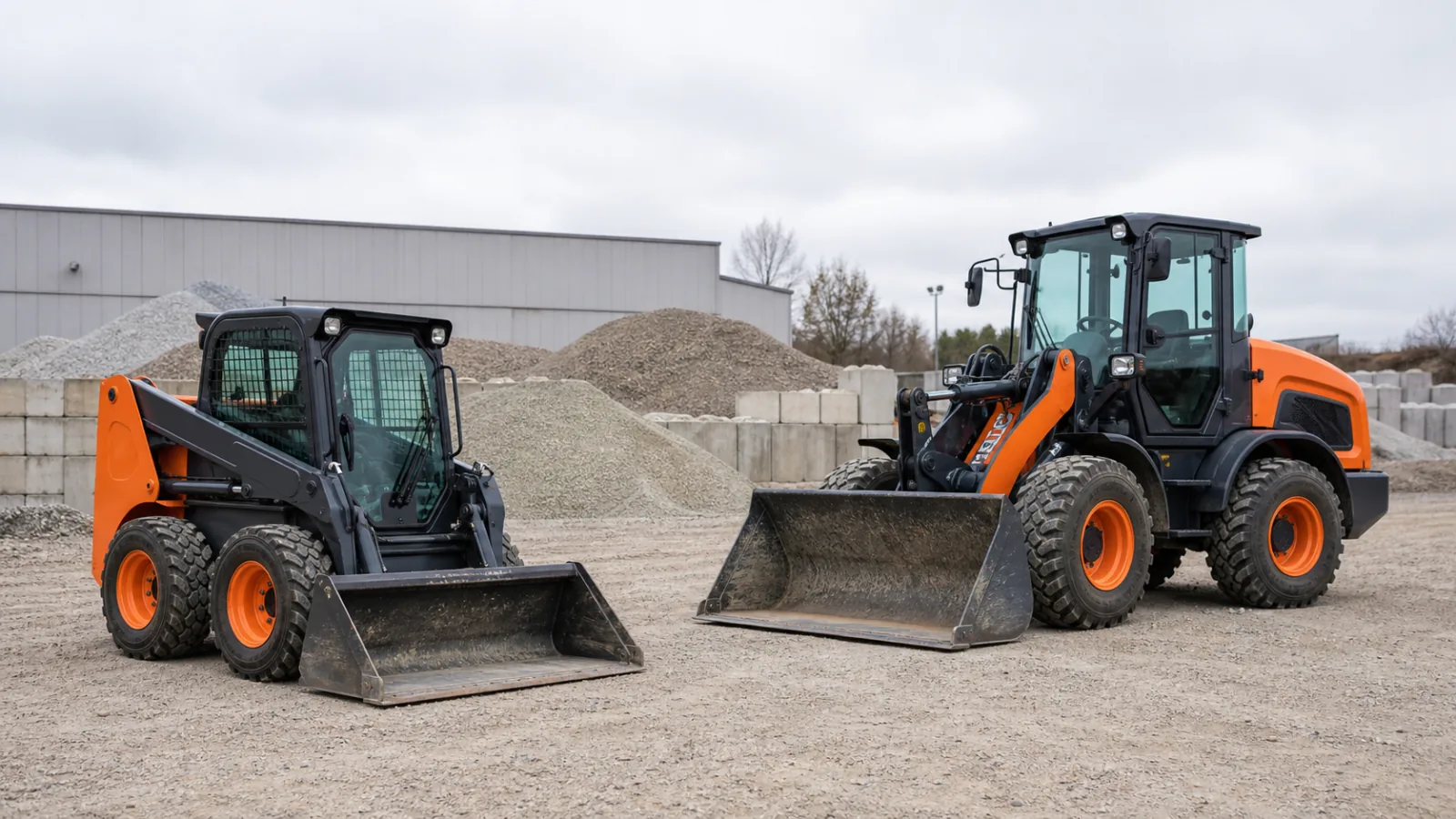
A skid-steer loader is compact and turns within its own length for tight sites; a conventional wheel loader is larger, articulates and moves more material per pass on open ground. This guide compares them on size, ground type, turning, attachments and cost so you can pick the right class. HONGLI builds wheeled and tracked skid-steer loaders (380–1,500 kg) — not articulated wheel loaders — so this is a buyer’s comparison, with our skid-steer range as one side of it.
We build both, so here is the comparison the way we walk buyers through it.
The core difference in one paragraph
A wheel loader is a purpose-built bulk mover: big bucket, articulated steering, high dump height, comfortable at full pace for a full shift. A skid steer is a compact tool carrier: small footprint, turns within its own length, and swaps between dozens of attachments in minutes. One is a specialist that does its one job at scale; the other is a generalist that does twenty jobs at small scale. Most wrong purchases come from buying the generalist for a specialist’s workload, or the reverse.
Footprint and maneuverability
The skid steer wins everywhere space is the constraint. It works inside barns, between greenhouse rows, through standard gates and on cramped urban sites. Its skid-turning needs no swing room a wheel loader’s articulation demands.
The trade-off is what skid-turning does to soft surfaces: dragging wheels or tracks across turf or fresh grade scuffs it. Wheel loaders steer through an articulating frame and roll through turns — gentler on finished surfaces, far hungrier for room.
Bucket size and real productivity
Volume moving is arithmetic the skid steer cannot win. A typical skid steer carries a fraction of a wheel loader’s bucket, sits lower (which means lower dump height into trucks and hoppers), and travels slower loaded. If the day’s work is loading trucks from a stockpile, the wheel loader moves several times the material per hour — and per liter of fuel. The honest rule: count the tons you move on your busiest day; past a few dozen tons daily, the wheel loader stops being optional.
Attachments and versatility
Here the skid steer is the undisputed champion. The standardized quick-attach plate carries buckets, pallet forks, augers, trenchers, sweepers, breakers, grapples and more — a rental fleet’s dream and a small contractor’s whole business model. One carrier, many trades.
Wheel loaders take attachments too — forks, larger buckets, grapples — but the ecosystem is narrower and changeovers are less central to how the machine earns its living.
Ground, climate and stability
Wheel loaders carry their weight on a longer wheelbase and larger tyres: better on slopes, steadier with a full bucket high in the air, more comfortable across rough yards at speed. Skid steers are nimble but short-coupled — fine on firm ground, busier and bouncier over rough terrain, and more affected by an overloaded bucket. On genuinely soft ground, the honest answer is often neither: that is crawler loader territory.
Moving between sites
A skid steer rides on a light trailer behind a pickup — for landscapers, utility crews and rental firms, that is half the machine’s value. A wheel loader needs a proper low-loader and planning. If the machine changes address weekly, the skid steer’s transportability may decide the question by itself.
Cost: purchase, running and resale
A skid steer costs meaningfully less to buy than a wheel loader of useful size, burns less fuel per hour, and rents out across more job types. But cost per ton moved tells the opposite story at volume: the wheel loader’s bigger bucket spreads its costs across far more material. Match the machine to the workload and either one is the cheap option; mismatch it and either one is expensive. (价格细节见 KB-8 装载机价格篇 — 上线后挂链)
Operators, visibility and daily reality
Spec sheets miss the human factors that decide how a machine actually performs on your site. Wheel loaders seat the operator high with good sightlines over the bucket, in a cab built for eight comfortable hours — fatigue matters when the job is repetitive loading. Skid steers put the operator low, close to the work, with the load frame around them; visibility to the sides and rear is tighter, which is workable on an open yard and demands real discipline on a site with people moving through it.
Maintenance follows the same pattern as the machines’ temperaments. Skid steers are simple and their parts are small and cheap, but they live hard lives and wear accordingly. Wheel loaders cost more per service item and reward routine care with very long working lives — well-maintained loaders commonly outlast the trucks they load. Whichever you choose, the question to ask the factory before ordering is the same: parts catalog, wear-item availability, and who answers the phone when something stops.
A decision checklist
Choose the skid steer if most of these are true: working width under 2.5 m matters; the job list changes weekly; attachments are central; the machine travels between sites; daily tonnage is modest.
Choose the wheel loader if these are true: the core job is loading or rehandling bulk material; trucks or hoppers need filling fast and high; the machine lives on one site; daily tonnage is the headline number.
Plenty of operations need both
A farm loads grain with the wheel loader and cleans barns with the skid steer. A contractor mass-excavates with one and landscapes with the other. If that is you, there is a practical note worth knowing: both machines — plus forklifts and attachments — can ship together from one factory in a mixed container, which is how many of our dealer customers consolidate orders.
Wheel loader vs front loader: what do the names mean?
A front loader or front-end loader describes a machine that carries a loader bucket at the front. A wheel loader is a specific, articulated, rubber-tired type of front-end loader. In equipment searches, “front loader” may also refer to a tractor with a loader attachment, so confirm whether the buyer means a dedicated wheel loader, a tractor loader or a skid steer.
A skid steer loader is also a wheeled loading machine, but it is not normally called a wheel loader. It turns by varying wheel speed on each side, while a wheel loader typically steers through an articulated center joint. This distinction affects turning behavior, ground disturbance, lift capacity and the space needed to work.
Information to send when requesting a loader quote
Provide the material to be handled, required lift height, target bucket capacity or load weight, working surface, site width and preferred attachments. These details make it easier to compare a skid steer loader with a compact or full-size wheel loader for the actual job.
FAQ
Can a skid steer replace a wheel loader?
Only at low volumes — a skid steer can do a wheel loader’s job slowly, but past a few dozen tons of material a day its small bucket and low dump height make it the expensive way to move material.
Which is better for a small farm?
Most small farms get more total use from a skid steer because of attachments and barn access; farms moving serious grain, silage or manure volumes step up to a compact wheel loader, and many run both.
Is a skid steer cheaper than a wheel loader?
Yes, to buy and to transport — but cost per ton moved favors the wheel loader at volume, so the cheaper machine is the one matched to your workload.
What about a compact wheel loader as a middle option?
A compact wheel loader is a genuine third answer: smaller than a full-size loader, gentler on surfaces than a skid steer, with better dump height and operator comfort than either expects at the size — the trade-off is that it matches neither the skid steer’s attachment range nor the big loader’s bucket. For farms and yards whose tonnage has outgrown a skid steer but whose gates have not widened, it is often the machine that actually fits the life. Tell us the working width you must pass through and the tons you move on a busy day, and we will tell you which of the three it points to.