
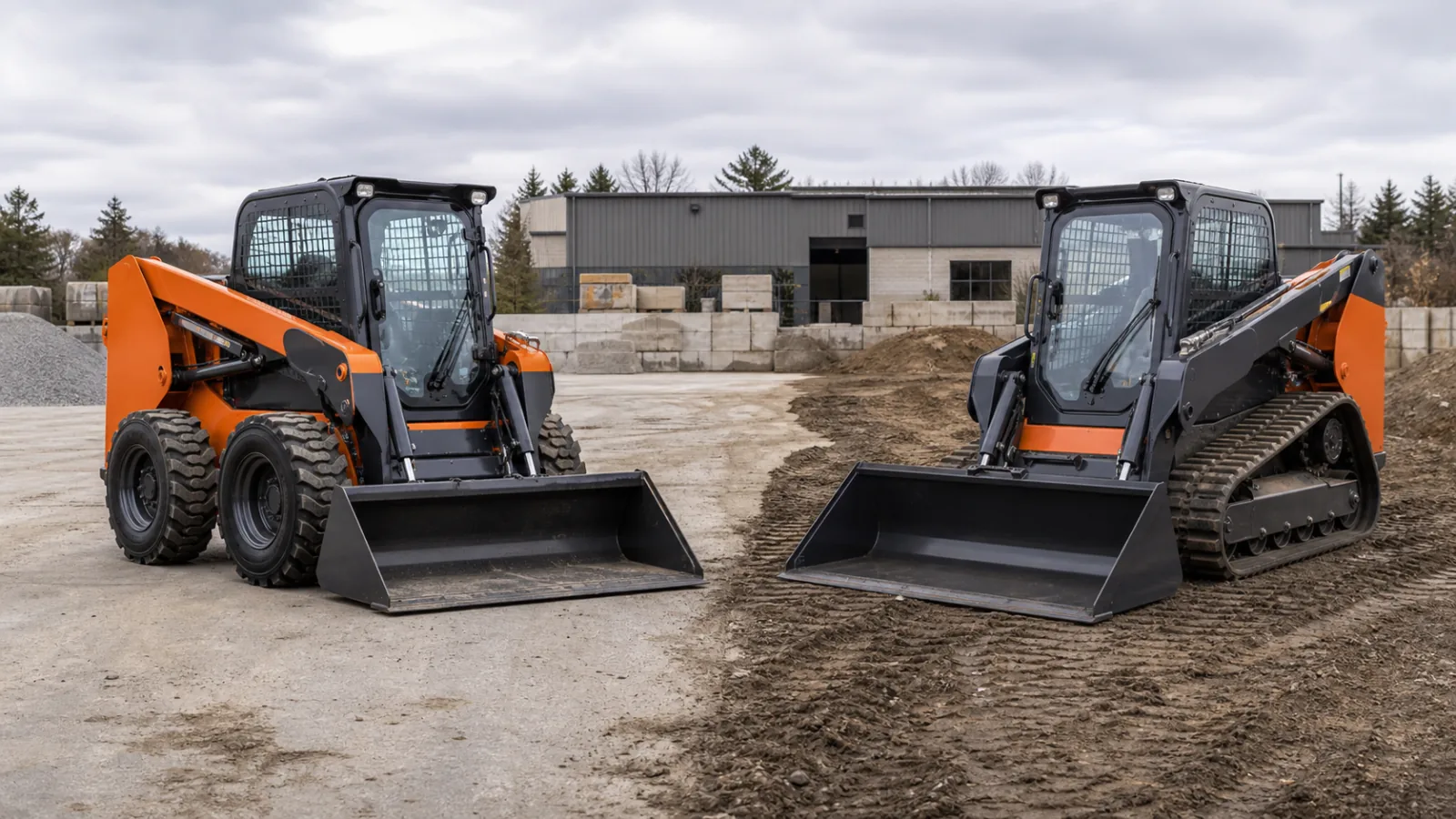
Choose a tracked skid-steer loader for soft, wet or muddy ground, and a wheeled skid-steer for hard, paved or dry surfaces. Tracks spread the machine’s weight over a larger contact area, so ground pressure drops to roughly 4–6 psi against 30–35 psi for tyres (industry figures
Wheeled vs tracked at a glance
| Attribute | Wheeled skid-steer | Tracked skid-steer (CTL) |
|---|---|---|
| Ground pressure | ~30–35 psi | ~4–6 psi |
| Best ground | Hard, paved, dry | Soft, wet, muddy, sloped |
| Traction | Good on firm ground | High on soft / loose ground |
| Top speed | Faster | Slower |
| Up-front cost | Lower | ~15–20% higher [typical] |
| Running / wear cost | Lower (tyres are cheap) | Higher (track wear) |
| HONGLI range | HLY, 380–1,500 kg | HLT, 700–1,500 kg |
Why ground pressure decides it
Ground pressure is the machine’s weight divided by its contact area. Tracks have a far larger contact area than four tyres, so they press down with about 4–6 psi versus 30–35 psi [typical]. Low ground pressure keeps a tracked loader on top of soft, wet or freshly graded ground, and reduces rutting on turf and finished surfaces. On hard, paved ground that advantage disappears, and wheels win on speed and cost.
Where wheels win
A wheeled skid-steer is faster, cheaper to buy and cheaper to maintain, since tyres cost a fraction of a track set. On firm yards, paved sites, farms with hardstanding and roadwork, the wheeled machine does the same job for less. HONGLI’s wheeled HLY range runs from 380 to 1,500 kg rated operating load.
Where tracks win
A tracked loader earns its higher cost on soft, wet, sloped or easily rutted ground: muddy sites, fieldwork, landscaping and snow. Lower ground pressure and a larger footprint give grip and flotation that tyres cannot match. HONGLI’s tracked HLT range runs from 700 to 1,500 kg.
A note on “wheel loaders”
A wheeled skid-steer is not an articulated wheel loader. Skid-steer loaders pivot in place by skidding each side; wheel loaders articulate and move more material per pass on open ground. HONGLI builds skid-steer loaders only — wheeled and tracked — not articulated wheel loaders.
FAQ
Wheeled or tracked skid-steer — which is better?
Neither overall. Tracked suits soft, wet or muddy ground; wheeled suits hard, paved or dry ground and costs less.
What is ground pressure, and why does it matter?
It is the machine’s weight over its contact area. Tracks run ~4–6 psi vs ~30–35 psi for tyres, so tracks float over soft ground where wheels sink.
Are tracked loaders more expensive?
Yes — about 15–20% more up front [typical], plus higher track-wear cost. They pay off on soft or sloped ground.
Does HONGLI make wheel loaders?
No. HONGLI builds wheeled and tracked skid-steer loaders only, not articulated wheel loaders.
What sizes does HONGLI offer?
Wheeled HLY from 380 to 1,500 kg and tracked HLT from 700 to 1,500 kg rated operating load.
Related: /loaders/wheeled-skid-steer-loader/ · /loaders/tracked-skid-steer-loader/ · /blog/skid-steer-vs-wheel-loader/ · /get-a-quote/