
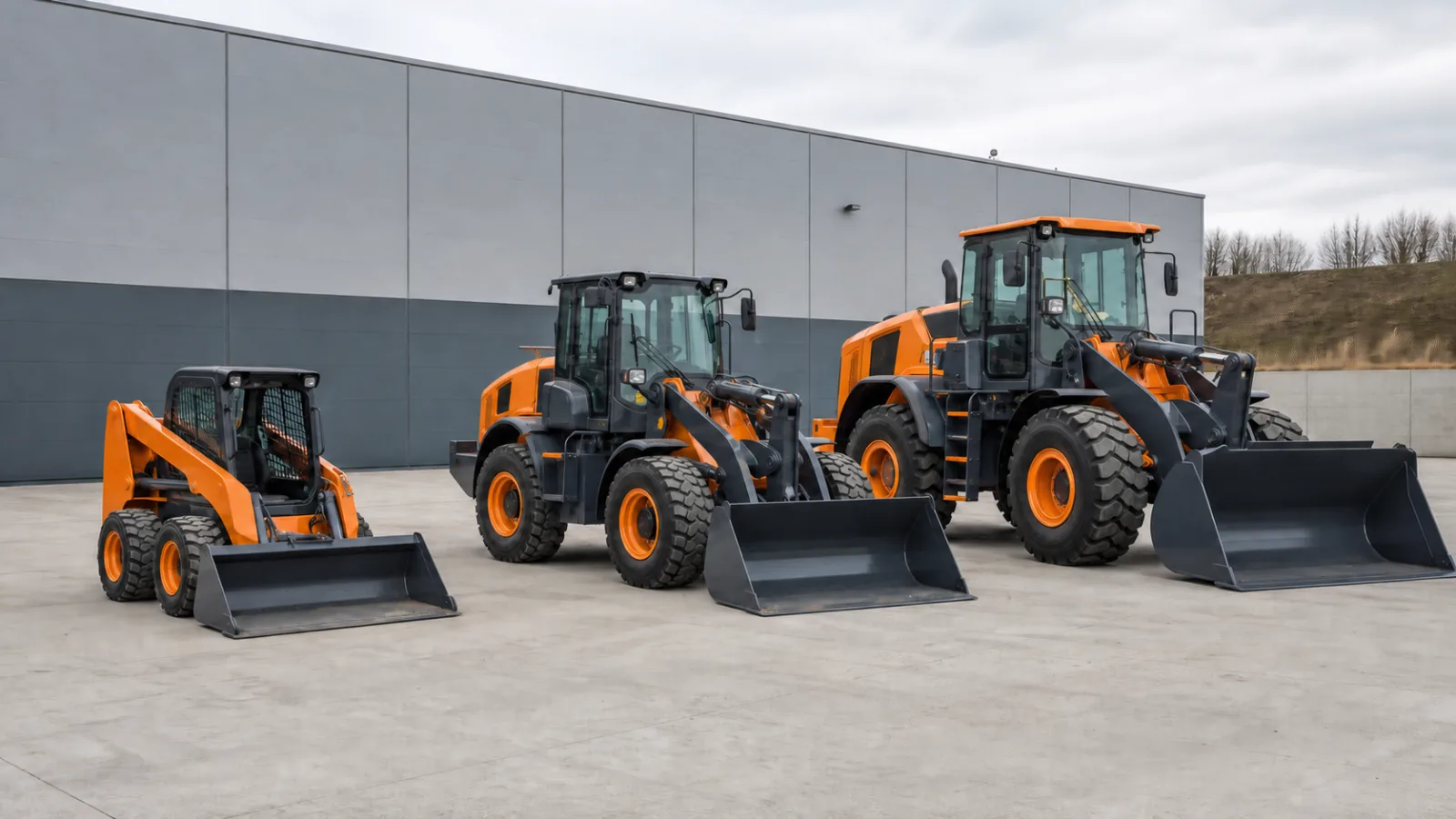
Wheel loader prices cannot be compared accurately from a model name or advertised factory price alone. The final quotation depends on loader size, rated load, bucket, engine and emissions configuration, drivetrain, tyres, cab, attachments, order quantity and delivery term. The fastest way to obtain a useful price is to send every supplier the same job requirements and ask for an itemised EXW, FOB or CIF quotation.
HONGLI manufactures wheeled and tracked skid steer loaders, not articulated wheel loaders. This independent buyer guide explains how wheel loader quotations are built and helps compact-loader buyers decide when a skid steer is the more practical and economical option.
How much does a wheel loader cost?
There is no single dependable wheel loader price that applies across all sizes and markets. A compact loader for a farm or yard, a mid-size construction loader and a heavy quarry loader require very different chassis, engines, axles, hydraulics, tyres and shipping arrangements. Online figures may also omit the bucket, compliant engine, cab options, freight, import duty or inland delivery.
Instead of relying on an unsupported price range, divide the machine requirement into the following classes and request like-for-like quotations:
| Loader class | Typical buying priority | Details that must match |
|---|---|---|
| Compact loader | Access, manoeuvrability and attachment flexibility | Machine width, rated load, dump height, bucket and auxiliary hydraulics |
| General construction loader | Loading output, durability and travel efficiency | Operating weight, bucket capacity, engine, axles, tyres and cycle requirements |
| Heavy-duty or quarry loader | Production, impact resistance and uptime | Material density, payload, reinforced bucket, cooling, tyres and service support |
Buyer rule: if two offers have different rated loads, bucket types, engine standards or Incoterms, they are not directly comparable even if both are described as a “wheel loader price.”
What determines the loader price?
| Price factor | What to specify in the RFQ | Why it changes the quotation |
|---|---|---|
| Rated load and material | Maximum load and material density | Chassis, axles, counterweight and hydraulics must suit the working load. |
| Bucket | Capacity, width, cutting edge and material type | A general-purpose, light-material or heavy-duty bucket has a different build and application. |
| Engine and destination | Country of use and required emissions standard | Engine configuration and compliance documentation vary by market. |
| Drivetrain and hydraulics | Duty cycle, travel distance and attachment flow | Transmission, pumps and auxiliary circuits affect performance and cost. |
| Cab and controls | Canopy or enclosed cab, heating, air conditioning and control type | Operator environment and optional controls add components. |
| Tyres and site | Surface, debris, mud, slopes and travel conditions | Tyre pattern, construction and protection must match the site. |
| Attachments | Bucket, forks, grapple, quick coupler or other tools | Attachments and couplers must match capacity and hydraulic requirements. |
| Order and delivery | Quantity, Incoterm, destination port and final address | Packaging, container utilisation, freight, insurance and local delivery affect total cost. |
EXW, FOB, CIF and landed wheel loader cost
A low factory figure is not necessarily the lowest delivered cost. Ask suppliers to identify the Incoterm, named place or port, included equipment and quotation validity.
- EXW: the buyer normally arranges collection from the seller’s premises and most onward transport.
- FOB: the quotation normally covers delivery and export handling to the named port of shipment, subject to the agreed Incoterm.
- CIF: the seller also arranges freight and insurance to the named destination port, while destination charges and import obligations may remain.
- Landed cost: the complete budget through import clearance and delivery to the buyer’s site.
Planning formula: machine price + selected options and attachments + export packing + freight + insurance + duty and tax + clearance and port charges + inland delivery. Confirm the exact responsibility split in the sales contract and check destination charges with a freight forwarder or customs broker. See our import-duty planning guide for the information buyers should collect before shipment.
New versus used loader prices
A used wheel loader may have a lower purchase price, but ownership cost also includes inspection, immediate service, wear parts, repairs and downtime. Compare a used machine only after checking:
- Verified operating hours, serial number and service history.
- Cold start, smoke, leaks, cooling system and engine condition.
- Transmission response, brakes, axles and differential noise.
- Hydraulic pressure, cylinder leakage and hose condition.
- Articulation-joint play, frame repairs and structural cracks.
- Tyre wear, bucket pins, cutting edge and attachment condition.
- Parts availability, inspection report and warranty scope.
Use total expected cost during the intended ownership period—not purchase price alone—as the comparison. A cheaper loader can become the more expensive option if it causes repair delays or cannot meet the required loading cycle.
Wheel loader or skid steer: which is better value?
A wheel loader generally fits repeated loading, longer travel distances and larger bucket volumes. A skid steer loader fits tighter sites, frequent attachment changes and work where turning space is limited. Compact-loader buyers should compare the two by rated operating capacity, dump height, machine width, ground surface, travel distance and attachment plan.
| Application condition | Usually the stronger candidate |
|---|---|
| Large-volume loading and longer travel | Wheel loader |
| Tight access and short turning radius | Skid steer loader |
| Frequent changes between bucket, forks and hydraulic tools | Skid steer loader |
| Soft or uneven ground requiring lower ground pressure | Tracked skid steer or a suitably configured loader |
| High dump requirement or dense material | Compare verified capacity and load charts for the exact models |
For a deeper application comparison, read skid steer vs wheel loader. HONGLI’s available options include wheeled skid steer loaders, tracked skid steer loaders and compatible loader attachments.
Loader quotation checklist
Copy the following information into your loader RFQ. Complete inputs reduce follow-up questions and make quotations easier to compare:
- Material handled and approximate density.
- Maximum load, required bucket capacity and attachment types.
- Required dump height, machine width and site access limits.
- Ground surface, slope, travel distance and daily operating hours.
- Destination country, destination port and final delivery location.
- Required emissions standard, cab specification and climate options.
- Quantity, target delivery period and preferred EXW, FOB or CIF term.
- Required inspection, documentation, warranty and spare-parts package.
Example request: “Please quote one compact loader for handling [material] at [maximum load], using a [bucket/attachment], with a required dump height of [value]. The machine will work on [surface] for [hours] per day. Destination is [country/port]. Please provide the exact model, full specification, included attachments, warranty, production estimate, packing details and separate FOB and CIF prices.”
Need a compact loader quotation?
Send your material, load, attachment, site and destination details. HONGLI will check whether a wheeled or tracked skid steer fits the application and prepare a configuration-based quotation. If the job requires an articulated wheel loader, use the same checklist to obtain comparable offers from the appropriate supplier.
Request a Loader Quote · Discuss the Application on WhatsApp · Compare HONGLI Loaders
Wheel loader price FAQ
Why do wheel loader quotations vary so much?
Quotations may cover different loader classes, rated loads, buckets, engines, emissions configurations, cabs, tyres, attachments and delivery terms. Compare the complete specification and Incoterm before comparing totals.
Is an advertised loader price the landed price?
Usually not. Confirm whether it is EXW, FOB, CIF or another term, what equipment is included and which freight, import and local-delivery costs remain the buyer’s responsibility.
What should a wheel loader quotation include?
It should identify the exact model, rated load, operating weight, bucket, engine, drivetrain, hydraulics, tyres, cab, attachments, warranty, packing, production estimate, Incoterm, named port or place and quote validity.
How can buyers compare loader prices fairly?
Send the same RFQ to each supplier, require an itemised quotation and compare identical capacities, configurations, attachments and delivery terms. Then calculate the landed cost and expected ownership cost.
When is a skid steer better value than a wheel loader?
A skid steer can be better when access is tight, attachment versatility matters and the required load and dump height fit a compact carrier. A wheel loader is normally better for larger-volume loading and longer travel.