
A forklift that raises a bulk bag off the floor has not proved that the lift is safe. The bag’s actual weight, suspended position, lift height and attachment must all fit the truck’s approved capacity for that exact configuration.
A short video of a forklift lifting a large bulk bag can be unsettling, especially when the rear of the truck appears to lighten. The clip does not tell us the bag’s verified weight, where its center of gravity sat relative to the forks, whether a lifting attachment was approved, or what the truck’s capacity plate said. It therefore cannot establish a single cause. It can, however, illustrate a common planning mistake: treating a nominal “three-ton forklift” as if it can safely handle any load below three tons.
This article focuses on flexible intermediate bulk containers, often called FIBCs or bulk bags. It complements our general guides to forklift capacity and load centre and capacity changes caused by attachments. It is a buyer’s verification checklist, not permission to improvise a lifting method. If you handle bulk bags routinely, send the bag specification, maximum filled weight, required lift height and site layout through the Hongli contact page for a configuration review.
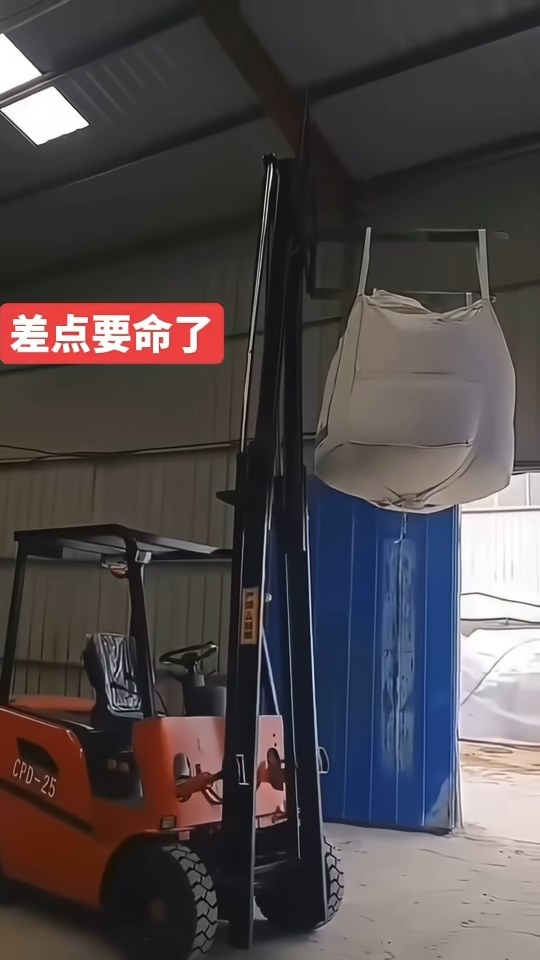
- What forward tip actually means
- Why bulk bags are a special case
- The five numbers and documents to verify
- A simple comparison that exposes a bad assumption
- Choose the handling method before choosing the truck
- What should make you stop the job?
- A buyer’s RFQ for bulk-bag work
- FAQ
- If a forklift can raise the bag, is the lift within capacity?
- Can I use the forklift’s standard forks through the bag loops?
- Does a bulk-bag attachment reduce capacity?
- Why does lift height matter if the bag weight stays constant?
- Are rear wheels lifting slightly a normal warning to continue slowly?
- What if the bag supplier provides no lifting instructions?
What forward tip actually means
A counterbalanced forklift relies on the relationship between the truck’s weight and the load moment around the front axle. When the load’s center of gravity moves farther forward, the overturning moment increases even if the load weight stays the same. OSHA’s load composition guidance explains why excess load moment can lift the rear steering wheels and lead to a forward tip.
The rear wheels becoming light is a warning, not an acceptable test of capacity. Steering and stability are being lost. Stop the operation, keep people clear and have trained personnel follow the site’s procedure for returning the load to a safe position. Do not try to solve it by adding improvised counterweight or asking someone to stand on the rear of the truck.
The relevant question is not “Did the bag leave the floor?” It is “Is the truck-and-attachment combination approved to support this bag at its actual horizontal position and the highest required lift height?” That answer comes from the manufacturer’s capacity data for the exact configuration, not from a trial lift.
Why bulk bags are a special case
A palletized load typically rests on forks. A bulk bag may be suspended from loops, a frame or a purpose-built lifting attachment. That can put the bag’s mass farther forward than the standard load center used on the forklift nameplate. The attachment adds its own weight and may move the effective load center farther out again. As the bag rises or moves, it can swing or change shape, introducing effects that a static pallet calculation does not capture.
There is also a bag-side question. A bag’s safe working load and lifting-loop design must be suitable for the intended handling method. A forklift rating does not certify the bag or its loops. Nor does a bag’s label certify that the forklift can carry it. Both sides of the system must be verified, including the attachment and any lifting frame.
Never assume that placing loops directly on bare forks is an approved method. The loops can slide, bunch or contact surfaces in ways the bag and truck manufacturers did not intend. Use only a handling arrangement confirmed for the particular bag, forklift and attachment. If the needed documentation is absent, choose an approved alternative or have a qualified lifting specialist design the operation.
The five numbers and documents to verify
| Item | What to obtain | Why it matters |
|---|---|---|
| Bag gross weight | Maximum filled weight, including liner and any packaging | Average fill weight is not the worst case |
| Bag geometry | Filled dimensions, likely center of gravity and hanging length | Determines clearance and where the load acts relative to the truck |
| Lift requirement | Highest point needed during pickup, travel and set-down | Capacity can vary with lift height and mast configuration |
| Truck-and-attachment rating | Current nameplate or chart for the exact truck, mast, attachment and load center | The original truck rating may not apply after an attachment is fitted |
| Bag and lifting method | Bag maker’s handling instructions, loop rating and approved attachment documentation | Confirms that the bag itself can be handled by the chosen method |
OSHA’s attachment guidance states that attachments affect capacity, visibility and stability, and that the truck’s nameplate must reflect the attachment. Its nameplate guidance ties capacity to the specified load center and lift height. These are practical procurement questions even outside OSHA jurisdictions; check local rules for the destination market.
A simple comparison that exposes a bad assumption
Imagine two bags with the same verified gross weight. Bag A is supported close to the carriage by an approved handling arrangement. Bag B hangs from an attachment that projects farther forward. The weight alone is identical, yet Bag B creates a larger forward moment because its center of gravity is farther from the truck. If Bag B must also be placed on a high rack, the relevant rating is the combination’s capacity at that required height.
This is a comparison, not a calculation to authorize a lift. The exact derating depends on the truck, mast, tires, attachment and load position. A field formula cannot replace the manufacturer’s chart. If a supplier quotes only the truck’s nominal tonnage, ask them to confirm the residual capacity for your bag and attachment in writing.
Our broader load-center guide explains the underlying moment. For bulk bags, the extra step is to document the suspended geometry and the bag’s own approved lifting method.
Choose the handling method before choosing the truck
Compare three possible workflows
A palletized bag can sometimes be handled as a supported load if the pallet, bag and loading arrangement are suitable and the forklift is rated for that load center and height. This can reduce the questions associated with suspension, but it introduces pallet condition, fork engagement and load security checks. It is not an automatic approval simply because a pallet is present.
A purpose-built bulk-bag attachment may be appropriate when the bag design and manufacturer instructions support that method. In this case, the attachment’s mass and projection are part of the truck rating, and the bag’s loop arrangement must match the device. Ask the supplier for the combined rating and the approved bag-handling procedure; do not rely on the attachment’s standalone capacity label.
A separate lifting system may be preferable when bags must be suspended for discharge, placed over equipment or lifted in a way a forklift cannot safely support. Compare the full process, including access for operators, exclusion zones and maintenance, before assuming the forklift already on site is the least expensive answer.
Begin with the bag supplier’s instructions. Determine whether the bag is intended to be lifted from its loops, supported underneath, placed on a pallet or handled by a dedicated device. Then identify a forklift or other lifting machine and attachment approved for that method. The correct solution may be a purpose-built bag lifter on a compatible truck, a palletized handling process, or a different lifting system altogether.
If the bag will move through a warehouse, record the aisle width, floor condition, door clearance, turning area and maximum set-down height. A truck sized for a pallet at floor level may not be appropriate for a suspended bag at a high discharge point. The route must also keep pedestrians away from the machine and the possible fall zone. Do not move a suspended load over people.
If the work is outdoors, a nominally larger forklift is not automatically the answer. Yard gradients, potholes, soft ground and wind can add constraints. Get a site-specific assessment and choose equipment rated for the surface and environment. Our warehouse forklift guide covers the base truck-selection factors; the bulk-bag method still needs its own review.
What should make you stop the job?
Do not proceed if the bag’s maximum weight is unknown; the loops or lifting points are damaged or undocumented; the proposed attachment is not approved for the truck; the current capacity plate does not cover the configuration; the load must be lifted higher or farther forward than the chart allows; the route exposes people to the suspended load; or the truck’s rear wheels lighten during an attempted lift.
The solution is not necessarily a bigger nominal tonnage. It may be a shorter-reach approved attachment, a different mast, a palletized process, a lower set-down point or another lifting system. Ask the supplier to compare the whole handling chain. A documented “no” is more useful than an unsupported capacity claim.
A buyer’s RFQ for bulk-bag work
What to check in the supplier’s reply
A useful reply identifies the exact truck, mast and attachment, the rated load at your required horizontal position and lift height, and the documents that will accompany the delivered configuration. It should also say which information depends on the bag maker or the site owner. A quotation that repeats “3,000 kg capacity” without addressing the suspended bag’s position has not answered the key question.
If the same forklift will also handle pallets, describe both duties. The equipment may need a changeable approved attachment, a different capacity class or two separate handling methods. Ask how the capacity plate will describe each permitted setup and how operators will distinguish them. Record the heaviest bag and highest set-down point, even if most daily lifts are smaller and lower.
Provide the supplier with the bag’s maximum filled weight and specification sheet; photos of its loops and normal filled shape; the pickup and set-down heights; the maximum horizontal reach; the number of lifts per shift; floor or yard conditions; and the destination country. Ask for the proposed truck model, mast, attachment, current capacity plate or chart, approved lifting method, operator training requirements and spare-parts support.
This information lets a supplier assess whether a Hongli forklift is appropriate and where the application needs another solution. It also gives your own safety and operations team a concrete plan to review before buying.
FAQ
If a forklift can raise the bag, is the lift within capacity?
No. Hydraulic power to raise a load does not establish stability or approved capacity at the bag’s actual position and height. Use the current chart for the exact truck and attachment.
Can I use the forklift’s standard forks through the bag loops?
Only if the bag maker and equipment manufacturer approve that handling method for the exact configuration. Do not assume that a loop fitting around a fork makes it safe.
Does a bulk-bag attachment reduce capacity?
Often yes. It adds weight and can move the load farther forward. Obtain the residual capacity of the truck-and-attachment combination instead of subtracting attachment weight from nominal tonnage yourself.
Why does lift height matter if the bag weight stays constant?
The truck’s approved capacity may change with mast height, and a raised suspended load introduces additional stability concerns. Check the rating at the highest required point of the job.
Are rear wheels lifting slightly a normal warning to continue slowly?
No. Treat light or lifting rear wheels as a stop condition. Keep others clear and follow the trained site procedure to lower and secure the load safely.
What if the bag supplier provides no lifting instructions?
Do not guess from the appearance of the loops. Obtain the required documentation or use a verified handling method designed by qualified personnel for that bag and load.
Planning regular bulk-bag handling? Contact Hongli with the RFQ details above. We can review the truck and attachment specification; your site team remains responsible for the approved lift plan and local operating rules.
About the author: Avicii Meng, Head of Technical Engineering, Hongli Machinery. This article addresses forklift selection and verification for bulk-bag work; it does not replace manufacturer instructions or a site-specific lifting plan.