
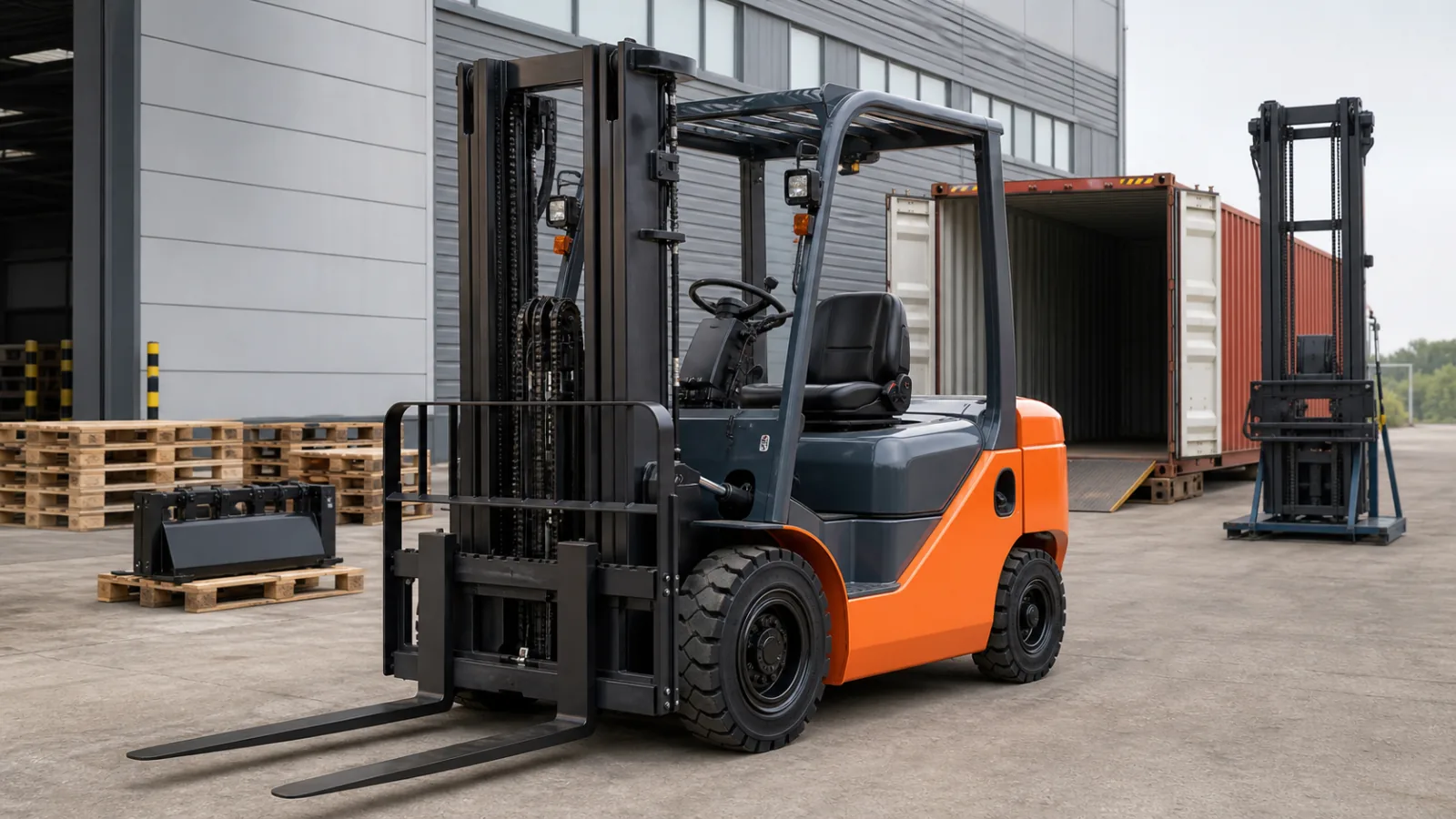
A new forklift’s price depends on capacity, power type and where it’s built. Entry diesel and electric counterbalance trucks from a China factory start far below European or Japanese brands; used trucks cost less but carry wear and parts risk. This guide breaks down new versus used ranges, electric versus diesel, and the landed cost of importing — FOB price, freight, duty and clearance — so you can compare a factory-direct HONGLI quote against local pricing.
One note on who is writing this: Hongli Machinery is a forklift factory in Shandong, China. We will tell you below where Chinese-built machines genuinely save money and where the comparison deserves more care than a price tag.
Quick answer: typical new forklift price ranges
| Forklift type | Established Western brands | Chinese-built (FOB) |
|---|---|---|
| 1.5–2.5 t electric | $25,000–$40,000 | $8,000–$18,000 |
| 3 t electric | $30,000–$45,000 | $10,000–$22,000 |
| 2.5–3.5 t diesel | $25,000–$40,000 | $9,000–$20,000 |
| 3 t LPG | $28,000–$42,000 | $10,000–$20,000 |
| 10–16 t heavy duty | $80,000–$250,000 | $35,000–$120,000 |
These are broad market reference ranges, not quotes — battery type, mast, options and order quantity move every figure. For an exact price on a specific configuration, a factory will quote you against your spec in a day.
The six things that actually drive forklift price
1. Capacity. Price does not climb linearly with tonnage — it jumps in steps. A 3-ton truck does not cost 50% more than a 2-ton; but past 5 tons, frames, axles and masts change class and so does the invoice.
2. Power source. Diesel and LPG trucks of the same capacity usually cost less upfront than electric once you include the battery — and the battery is the swing factor. Lead-acid keeps the entry price down; lithium adds thousands upfront and pays it back only if your duty cycle is heavy enough. (More in our battery guide.
3. The mast. A standard duplex mast is the baseline. Triplex masts, full free lift, higher lift heights and wider carriages each add real cost. Buyers routinely over-specify lift height “to be safe” — measure your highest beam instead; it is the cheapest cost cut available.
4. Options and attachments. Side shifters, fork positioners, cabins, non-marking or solid tyres, cold store packages — each is modest alone; together they can add 10–20% to a base machine.
5. Brand and country of manufacture. The same broad specification can differ by a factor of two or more between an established Western brand and a Chinese factory. What you are paying for in the premium: brand resale value, dealer network density, and sometimes — not always — component pedigree. What you are not necessarily paying for: a different ability to lift 3 tons, eight hours a day.
6. Certification and market options. CE-compliant configurations, market-specific lighting and emissions equipment add cost. They are not the place to save money: a machine your inspector rejects is the most expensive machine you can buy.
New vs used forklifts
A used 3-ton truck in decent condition typically sells for 30–60% of its new price, depending on hours and battery state. Used makes sense for light, occasional duty. It stops making sense when the machine is daily infrastructure: an old battery alone can cost a third of a new Chinese-built truck, and downtime costs more than depreciation. Run the comparison against a new factory-direct machine before assuming used is the budget option — for many buyers the gap is smaller than they expect.
If you do go used, inspect like the seller is hiding something: hour meter against service records, mast play and chain wear, hydraulic cylinders for weeping, and — on an electric — a load test on the battery, because “battery replaced recently” is the most expensive sentence in the used market when it turns out to be optimistic. A used truck with a tired battery and worn mast can cost more to put right than it saved you at purchase.
The costs after the purchase price
Purchase price is the loudest number but rarely the largest one over a machine’s life:
- Energy. Electricity per operating hour costs a fraction of diesel or LPG. Over five years of full shifts, the fuel difference alone can exceed the truck’s purchase price.
- Maintenance. Electric trucks skip engine oil, filters, coolant and exhaust repairs. Diesel maintenance is simple but constant.
- Battery replacement. The deferred cost of electric: a lead-acid battery has a finite cycle life, and replacement is a four-figure event. Plan for it; it is still usually cheaper than years of diesel.
- Parts and support. A cheap machine without parts supply becomes expensive the first week it stands idle. Whoever you buy from, ask the spare parts question before the price question.
Buying factory-direct from China: what changes
The FOB prices in the table are factory prices. To compare honestly with a local dealer quote, add your real landed costs: sea freight, insurance, import duty and local registration where applicable. Even after those, the landed cost of a Chinese-built truck is typically well below a Western-brand equivalent — that is why dealers and rental fleets, who run the numbers hardest, import in containers. (Full breakdown: our import cost guide.
What the price does not include is a local dealer’s showroom and service van. If you have your own workshop — as dealers, rental companies and most industrial buyers do — you keep that margin. If you do not, factor in how you will service the machine; a good factory backs you with parts catalogs, diagrams and remote diagnosis, but spanners stay local.
Should you rent instead of buying?
Rental rates for a 3-ton class truck commonly run a few hundred dollars per week, varying widely by market. The arithmetic is blunt: if you need the machine for more than a year of regular use, ownership usually wins — often within months when measured against factory-direct purchase prices. Renting earns its keep for seasonal peaks, short projects and trying a capacity class before committing. If you find yourself renewing a rental contract for the third time, you are paying for someone else’s machine; price a purchase.
There is a middle path worth knowing about, too: rental companies themselves are among the largest buyers of factory-direct Chinese forklifts, precisely because low acquisition cost is what makes their weekly rates work. One of our own 2026 shipments was 10 electric forklifts to a rental company in Chile. If renting keeps looking attractive in your market, that tells you what the local rental fleet paid per truck — and that you could too.
How to get an exact price
Any factory worth buying from will quote a specific configuration quickly. To get a same-week answer, send: capacity and load centre, lift height, power source (or ask for a recommendation), tyres and environment, options, quantity, and your destination port. At Hongli Machinery that quote — models, full specifications, FOB pricing — comes back within one working day.
FAQ
How much does a 3 ton forklift cost?
A new 3-ton forklift typically costs $10,000–$22,000 FOB from a Chinese factory, or $30,000–$45,000 from established Western brands, before options and shipping.
Are Chinese forklifts cheaper because of lower quality?
They are cheaper mainly because of lower production and labor costs and the absence of brand premium and dealer margin; quality varies by factory, which is why certificates, component lists and factory visits matter more than the brochure.
What is the cheapest way to buy a forklift?
For most business buyers, the lowest total cost is a new Chinese-built machine bought factory-direct in container quantity — provided parts supply and certification are verified before ordering.